
 +965 2292 4888


Daily Economic Update
25.01.2026
US: Trump threatens 100% tariffs on Canada for its trade deal with China; Europe makes progress on de-escalation after the US backed down. President Trump threatened to slap 100% tariffs on all Canadian goods if the country went ahead with a trade deal with China (which would lower Canadian import duties on some Chinese goods). At the WEF Davos meeting last week Canadian PM Carney had indirectly criticized the US’s coercive tactics to pressure trade partners and forcefully grab territory. Posting an altered map, Trump had shown Canada covered under a US flag last week and referred to Canadian PM as “Governor” Carney in his latest tariff threats. At the start of the year, the US administration has fueled geopolitical risks at unprecedented levels, with countries and blocs involving Venezuela, Iran, Greenland, Europe and now Canada, that is upending the current global order. However, the European Union will pause its retaliatory tariff package worth €93 billion on US goods for now after the US backed down on its own plan to slap additional 10% duties on eight European countries for opposing Trump’s Greenland takeover bid. Meanwhile, the European Parliament, which last week suspended ratification of the US-EU trade deal agreed previously, is now expected to resume discussions in order to vote on ratifying it following the latest de-escalatory developments.
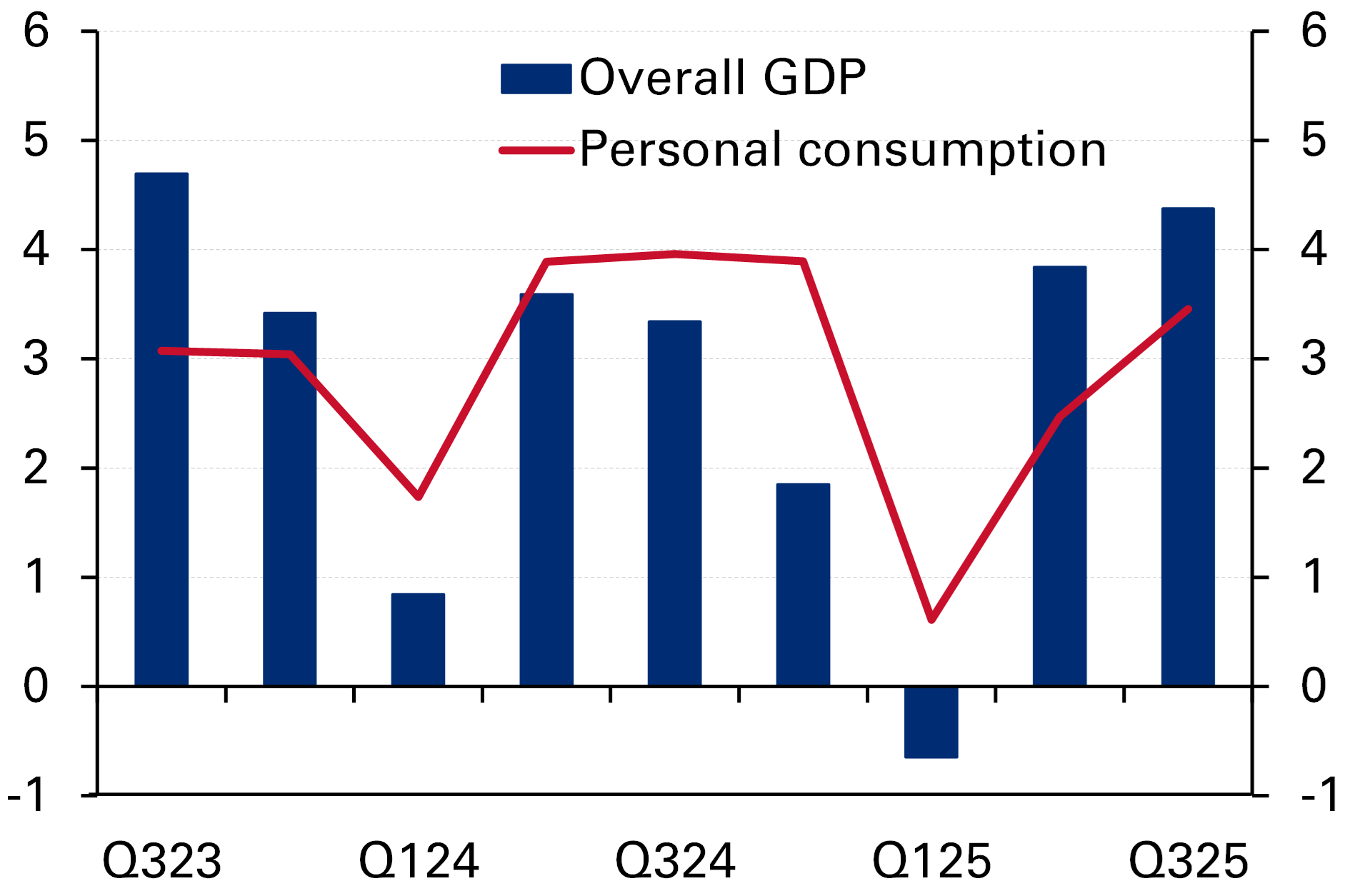
US: GDP growth in Q3 2025 revised slightly higher and weekly jobless claims continued to be low. GDP growth in Q3 2025 was revised slightly higher in the final estimate to 4.4% (q/q, annualized) from the 4.3% reported previously, improving also from 3.8% in Q2. Meanwhile, initial weekly jobless claims (w/e 17 January) were modest at 200K from 199K the previous week, while continuing claims (w/e 10 January) also dropped to 1.85 million from a downwardly revised 1.88 million the week before. Core PCE inflation in November slightly increased to 2.8% y/y from 2.7% in October but matched September’s reading. On a m/m basis, core PCE inflation was steady at 0.2% for the fifth consecutive month, signaling no material pickup in inflation though it remains significantly above the Fed’s 2% target. Similarly, headline PCE inflation inched up to 2.8% y/y in November from 2.7% in October. Finally, the S&P Global flash manufacturing PMI for January slightly rose to 51.9 from December’s 51.8, while the services measure was steady at 52.5.
Japan: The BoJ holds rates and increases GDP growth projections. As expected, the Bank of Japan voted on Friday to keep policy rates steady at 0.75%. The decision came after December’s headline inflation fell for a second consecutive month, to a multi-year low of 2.1% y/y, driven by falling food and energy prices. The BoJ increased its projections for GDP growth, forecasting 1% for FY2026, up from the 0.7% forecast in October, and 0.9% for FY2025 (from 0.7% previously). Also, Prime Minister Takaichi officially dissolved parliament and called for snap elections in early February, as she looks to capitalize on her popularity and improve her coalition’s razor-thin majority in parliament.
Eurozone/France: French government survives no-confidence votes; Eurozone composite PMI steady at 51.5 in January. The French government survived two no-confidence votes on Friday, after Prime Minister Lecornu, earlier in the week, invoked article 49.3 of the constitution—effectively circumventing parliament to pass the income side of the budget—after months of failed negotiations to agree on a budget for 2026. Lecornu will most likely invoke that same article to pass the spending side of the budget and face further no-confidence votes. The Prime Minister mentioned that the budget deficit for 2026 will not exceed 5% of GDP, below the 5.4% recorded in 2025 but above the EU's 3% cap. Meanwhile, the HCOB Eurozone flash composite PMI was steady at 51.5 in January, slightly below expectations of 51.8. The services PMI fell to a four-month low of 51.9 (52.4 in December), which was below expectations, while the manufacturing PMI increased to 49.4 from 48.8 in December, slightly above expectations.
UK: Business activity accelerates to a 21-month high in January. The S&P Global flash composite PMI for January rose to a 21-month high of 53.9 from December’s 51.4 on across-the-board improvements. The services gauge increased to a 21-month high of 54.3 from 51.4, while manufacturing also hit a 17-month high of 51.6 from 50.6 in December. However, as has been the case previously, details continued to be mixed, with output, new orders, export demand, and business optimism improving solidly in January but elevated price pressures and weak employment tempered the overall improvement. Firms shed jobs at a faster pace in January, while elevated staffing costs and other input price rises kept inflation high. Meanwhile, retail sales volumes surprisingly rebounded in December, by 0.4% m/m (2.5% y/y) from -0.1% (1.8% y/y) in November on a solid upturn in online sales. However, for Q4, retail sales fell 0.3% q/q (+2.1% y/y). After pre-Autumn-budget jitteriness during October and November, it appears that the UK economy gained some momentum at the end of the year, with January’s solid PMI readings also boding well for Q1 this year.
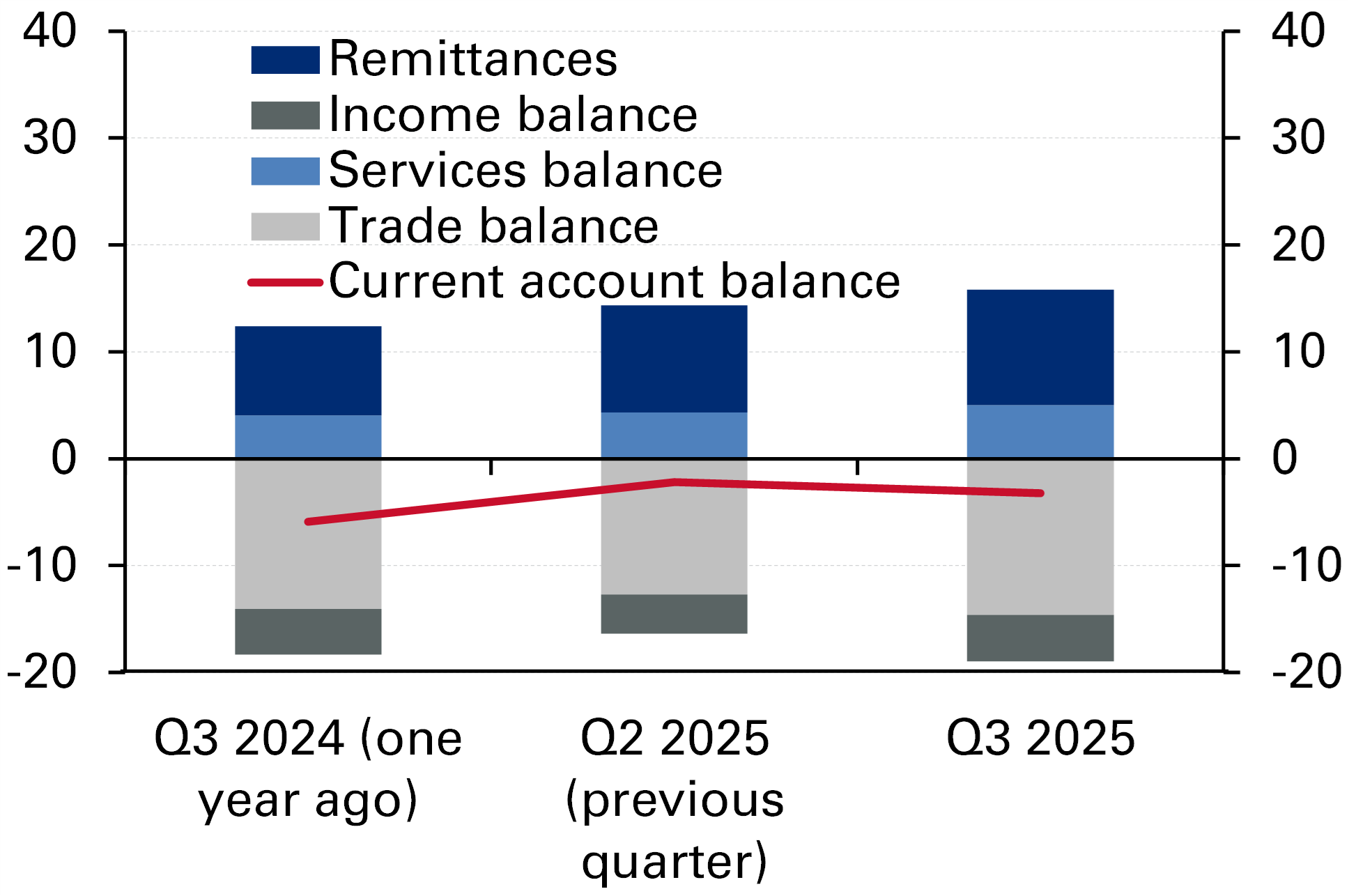
Egypt: Current account deficit widens in Q3 2025 despite stronger FX inflows. Central Bank of Egypt data for Q3 2025 (the first quarter of FY25/26) showed the current account deficit widening to $3.2 billion from a deficit of $2.1 billion in the previous quarter—and mainly due to higher natural gas imports. That said, this is still an improvement on the situation a year earlier ($5.9bn), and the stronger external position has been supported by strong growth in Egypt’s main foreign currency sources: workers’ remittances (+30% y/y to $10.8bn); tourism revenues (+13.8% y/y to $5.5 bn); and Suez Canal receipts (+12.4% y/y to $1.1bn). On the trade side, the non-oil trade deficit narrowed to $9.5 billion (-$390mn), helped by an increase in non-oil exports (+$1.9bn to $9.8 billion). Export growth was driven mainly by gold, electrical appliances, vegetables, fruits, and ready-made garments. However, non-oil imports also rose (+$1.5bn to $19.3bn), reflecting higher purchases of passenger cars, auto parts, and tractors. In contrast, the oil trade deficit widened by nearly $1 billion to about $5.2 billion, as petroleum imports climbed ($6.4bn) due to increased natural gas purchases. On the financial account, net foreign direct investments, though, remained stable at $2.4 billion, while net portfolio investments increased to $1.8 billion, up from a net outflow of $515 million in the previous quarter. The higher gas bill caused the broad balance of payment’s deficit to widen compared to the same quarter of the previous year (-$991mn to $1.6bn). Overall, the figures highlight improving underlying FX inflows, but, at the same time, underline Egypt’s continued vulnerability to energy import dynamics.
Saudi Arabia: Record year for tourism sector in 2025. Saudi Arabia’s tourism sector achieved a record year in 2025, attracting over 122 million domestic and international visitors who spent approximately SR300 billion ($80bn), according to preliminary Ministry of Tourism data. This represents a 5% rise in visitor numbers and a 6% increase in tourism spending compared with 2024, reflecting the kingdom’s rapid expansion of tourism offerings in line with its Vision 2030 goal of 150 million annual tourists. The strong performance was driven by wide-ranging regulatory reforms, increased investment, expanding cultural, leisure, nature, and business tourism options, and a full calendar of major international events. Ongoing improvements in infrastructure, licensing processes, investor support, and talent development have boosted visitor stays, raised per capita spending, and strengthened the sector’s long-term contribution to the national economy.