
 +965 2292 4888


Daily Economic Update
02.09.2026
Kuwait: Cabinet issues law allowing borrowing from the Future Generations Fund. Kuwait has issued Decree-Law No. 81 of 2026, allowing the government to borrow from the Future Generations Reserve Fund (FGF) to support the state's general reserve and finance development and fiscal needs, but under strict safeguards. Borrowing in any fiscal year is capped at 100% of the reserve’s average investment returns over the previous five audited years, while the total outstanding loan balance cannot exceed 10% of the reserve’s net asset value. (FGF reserves are not disclosed but KIA’s assets under management are thought to be more than $1.1 trillion, according to independent estimates, which would imply a loan balance cap of $110 billion or KD34 billion). Any new borrowing is prohibited if either limit is breached. Loans must be approved by the Cabinet and include details such as the amount, purpose, return, repayment period, schedule, and restructuring terms. The law requires that loans and related returns be recorded as assets owed to the Fund, that the state prioritizes their repayment from future budget surpluses, and that their cancellation or reduction be prohibited except through legislation. The move follows the approval of the liquidity and financing law of 2025 and is aimed at expanding the government's funding options while protecting the FGF’s assets. Kuwait’s decision to allow borrowing from the FGF reflects more than short-term geopolitical stress but rather the longer-term structural pressures on the public finances that have built up over the past decade which have resulted in recurring fiscal deficits in all but one year (FY2022/23) when oil prices were exceptionally high. After posting a larger than expected deficit of KD7.1 billion (15% of GDP) in FY2025/2026, an even wider deficit (around 20% of GDP) is projected for the current fiscal year (FY2026/27) amid ongoing disruptions to oil exports and supply chains from the conflict in the Gulf.
Saudi Arabia: Kingdom returns to global debt markets with strong investor demand. Saudi Arabia returned to international debt markets with a $3.25 billion sukuk issuance, split into 5 and 10-year tranches. The deal attracted strong investor demand, with the order book exceeding $16.5 billion, more than five times the amount raised, according to the National Debt Management Center (NDMC). Strong demand also allowed the Kingdom to secure significantly tighter pricing. Initial guidance was set at 100 basis points (bps) over US Treasuries for the five-year tranche and 110 bps for the 10-year tranche. Final spreads were tightened to 70 bps and 80 bps, respectively. The sukuk are expected to be rated Aa3 by Moody’s and A+ by Fitch. The issuance comes as Saudi Arabia faces elevated financing needs. The Kingdom recorded a SAR 125.7 billion budget deficit in Q1 2026 alone, more than double the deficit in Q1 2025 and equivalent to around three-quarters of the SAR 165.4 billion deficit projected for the full year. The Q1 deficit was financed entirely through debt markets. The latest issuance also comes as the NDMC and Saudi Aramco are separately negotiating new loans with international banks, highlighting the Kingdom’s continued reliance on debt markets to support its financing needs amid the challenging regional environment.
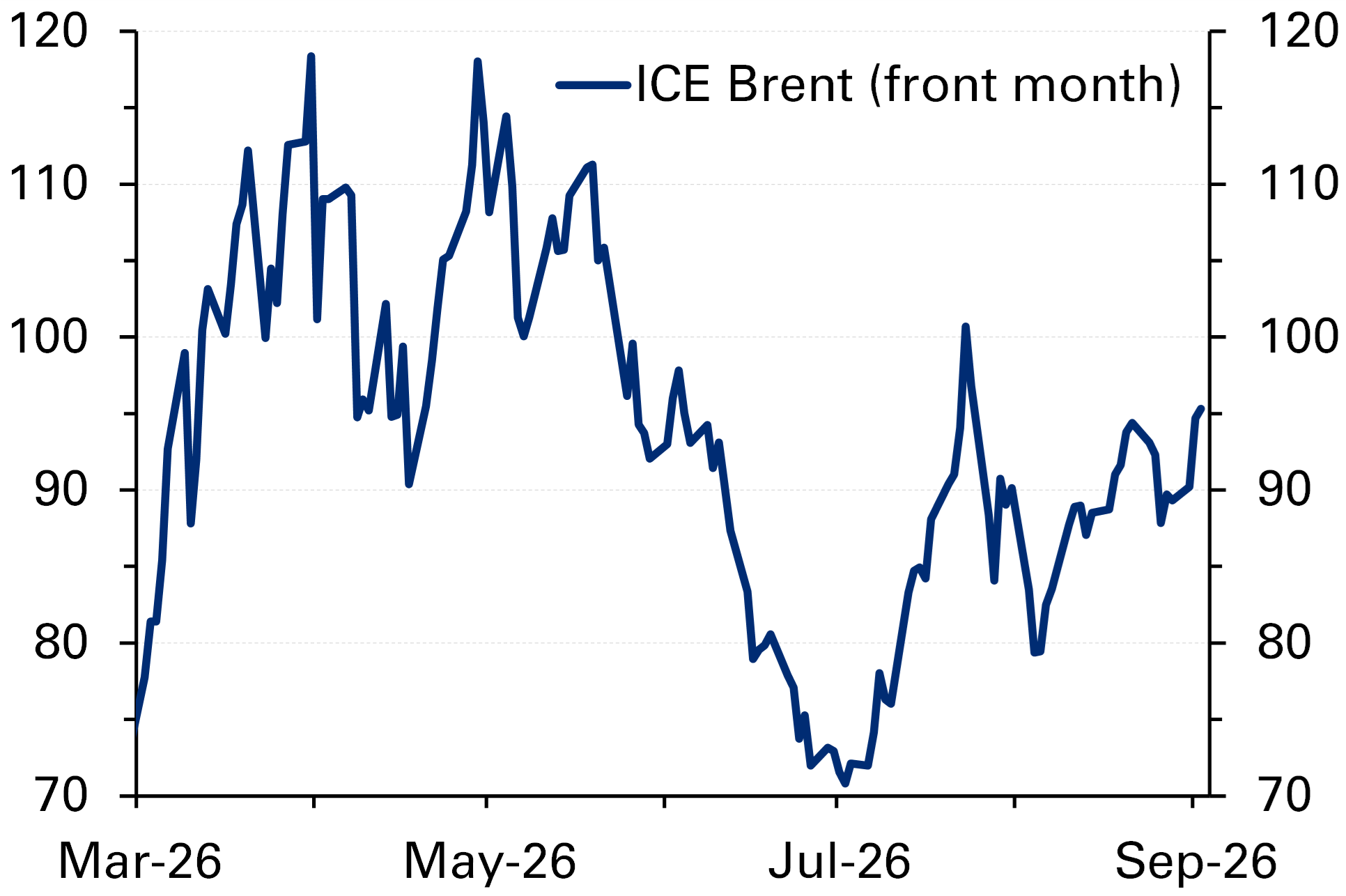
Oil: Prices jump amid renewed US-Iran conflict escalation. Brent crude futures surged 4.6% yesterday to settle at a five-week high of $94.7/bbl (+55% ytd) as renewed hostilities between the US and Iran prompted markets to reprice geopolitical risk higher once again. Sentiment deteriorated after US Central Command announced fresh strikes on Iranian targets in response to attacks on two oil tankers transiting the Strait of Hormuz. Tehran subsequently retaliated with strikes targeting US military assets in Jordan, Iraq, Kuwait, and Bahrain, marking yet another escalation in regional tensions. The latest developments have largely dashed hopes that last weekend's military exchange would remain contained, instead increasing the risk of a broader and more sustained confrontation. Meanwhile, refined petroleum product markets have also tightened considerably. US diesel futures climbed to a 52-month high yesterday after rising 51% over the past ten weeks, supported by refinery disruptions in both the Middle East and Russia. As a result, US diesel crack spreads, a key measure of refining profitability, surged to a record $107/bbl, highlighting acute shortages in middle distillates and reinforcing the strength of refined product markets, particularly middle distillates.
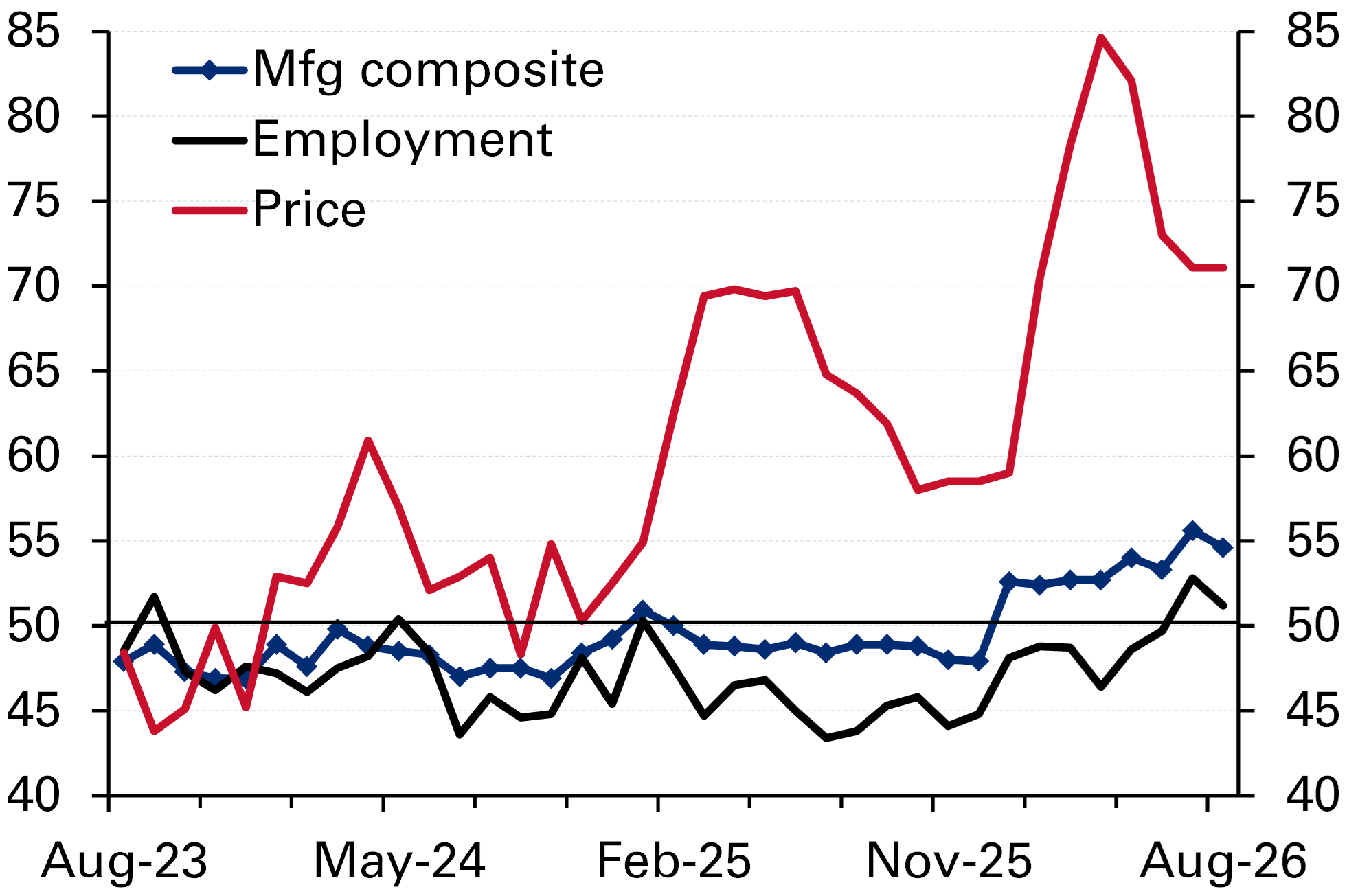
US: Fed Governor Barr sees need to hike rates if inflation remains high; JOLTS shows steady labor market conditions. Fed Governor Michael Barr stated that “if inflation appears not to be moderating sufficiently, then I think we should act decisively to raise rates.” However, he also mentioned that “if trends in the data give me some confidence that inflation is moderating on a path to 2%, then I think we can take a bit more time to assess our policy stance.” Recent commentary indicates that several Fed officials are increasingly becoming more wary of higher inflation risks. The futures market probability of a 25-bps interest rate hike in September has climbed to almost 70% currently, following Chair Warsh’s Jackson Hole speech last Friday. Still, a September hike is not a done deal as the upcoming non-farm payroll report (this Friday) and the CPI print for August could materially influence the FOMC outcome, while political considerations, especially given the mid-term elections in November, may also weigh on Warsh’s posture. Separately, the latest JOLTS data showed that the labor market continued to be generally stable, with job openings in July edging up to 7.27 million from a downwardly revised 7.18 million in June. The voluntary quits rate decreased to 1.9% from 2%; it has been hovering in the 1.9-2.0% range since July 2025. The hiring rate softened to 3.2% from 3.4%, but the layoffs rate also fell to 1% from 1.1%, indicating a continued soft hiring and low firing backdrop. Finally, the ISM manufacturing PMI dropped more than forecast to 54.6 in August from July’s over four-year high of 55.6 as new orders growth moderated (to 53.7 from 56.7) and the pace of headcount expansion weakened (to 51.2 from 52.8). However, the gauge of prices remained elevated at 71.1 (versus an average of 63.4 in 2025), unchanged from July, suggesting little respite from price pressures in the near term.
Eurozone: Inflation increases in line with expectations in August but the core rate tame. Inflation accelerated to 3.3% y/y in August from 2.9% in July, in line with expectations and marking its highest reading since September 2023. The increase was largely driven by a jump in energy inflation, which rose to 14.3% y/y in August from 10.3% previously, reflecting ongoing energy market pressures. Meanwhile, core inflation eased slightly to 2.4% y/y from 2.5%, indicating that underlying price pressures remain relatively contained, and the important services inflation softened to 3.0% from 3.3%. However, this is unlikely to deter the ECB from hiking rates on 10 September, with the futures market currently indicating more than a 95% probability of a 25-bps rate hike in that meeting.
UK: House prices rise modestly in August according to Nationwide. UK house prices ticked up slightly in August, increasing by 0.2% m/m after July’s fall of 0.1%, according to the Nationwide House Price index. On an annual basis, the increase in house prices accelerated to a still modest 1.6% from a downwardly revised and five-month low of 1.4% in July but missed the 2.1% consensus forecast. Nationwide noted that the subdued price performance partly reflected the uncertain economic landscape amid the ongoing Middle East conflict, resulting high inflation and rising market interest rates. We think that the near-term outlook for UK house prices remains muted given the possibility of monetary policy tightening, the anticipation of a further rise in inflation, a continued weak labor market and the uncertainty surrounding the Autumn budget in late October.