
 +965 2292 4888


Daily Economic Update
24.09.2026
Kuwait: Cabinet approves long-awaited mortgage law, unlocking new financing for prospective homeowners. Kuwait’s Cabinet has approved a draft law establishing a new mortgage financing framework for beneficiaries of the public housing welfare system, in a move aimed at supporting sustainable housing provision and expanding access to homeownership. The legislation allows eligible citizens to obtain both subsidized and non-subsidized housing finance, including the ability to combine the two, under regulations set by the Central Bank of Kuwait, with repayment periods extending up to 25 years. The framework covers the purchase of housing units from approved developers as well as construction on government-allocated plots, while maintaining state support through subsidized financing and guarantees provided via Kuwait Credit Bank in cases of borrower distress. The reform represents an important step toward deepening Kuwait’s housing finance market and increasing private sector participation in addressing the housing challenge. Additionally, the law should support medium-term economic growth by expanding bank credit and boosting residential construction activity and related sectors. While the reform addresses the financing side of the housing market, the main constraint is likely to remain the availability of housing units and land within the housing welfare system, meaning that housing supply will remain the key factor of the reform’s actual economic impact. The mortgage law will become effective once the bylaws are published, which should happen within six months following the law’s publication in the official gazette.
Egypt: CBE expected to keep rates unchanged today amid inflation risks. The Central Bank of Egypt’s (CBE) Monetary Policy Committee (MPC) is expected to keep its key policy rates unchanged at today’s meeting, maintaining a wait-and-see approach amid evolving inflation and external risks. While headline inflation eased to 14.5% y/y in August from 14.9% in July, core inflation edged up to 14.9% from 14.7%. Meanwhile, the potential for another fuel price increase at the Fuel Pricing Committee’s expected October meeting could put renewed pressure on prices and trigger second-round effects on inflation, particularly through transportation and other operating costs. With real interest rates remaining above 5%, monetary conditions are still relatively tight, giving the CBE room to maintain its current stance while assessing the impact of the regional conflict on inflation, capital flows, and the exchange rate. The CBE last kept rates unchanged in August, with the overnight deposit and lending rates at 19% and 20%, respectively.
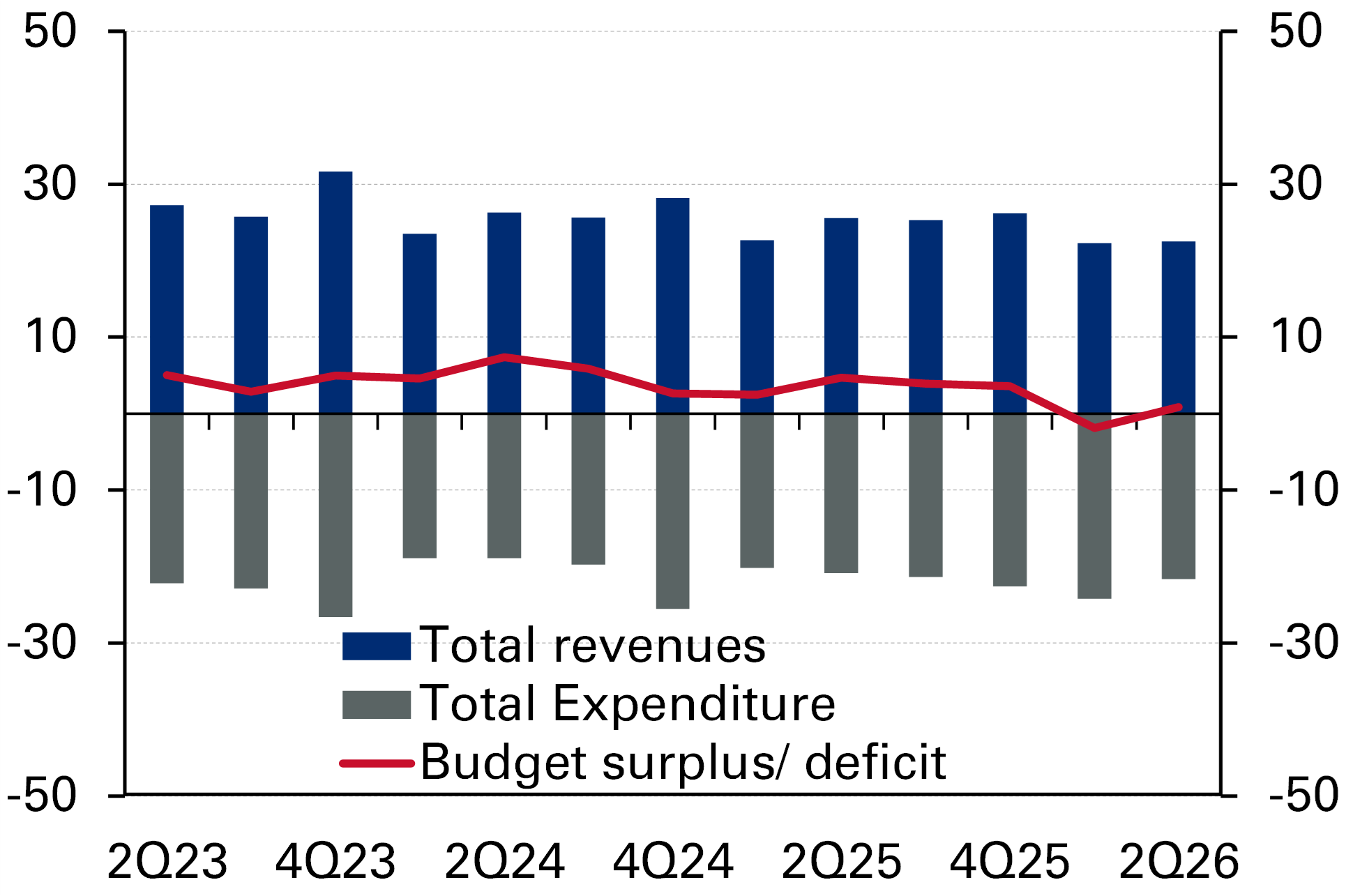
UAE: Fiscal position improved in Q2 despite disruptions to oil exports. Ministry of Finance data for Q2 2026 showed the UAE’s consolidated fiscal position proving more resilient than expected amid the regional conflict and the effective closure of the Strait of Hormuz (SoH) to shipping by Iran. The budget balance shifted to a surplus of AED4.5 billion (0.8% of pro-rated GDP), reversing the AED10.4 billion deficit recorded in Q1 (-1.9% of GDP). Total revenues declined to AED121 billion in Q2 (-0.8%q/q; -16.3%y/y), with the hit to oil revenues from shut-in oil production, down to 2.64 mb/d (-10.6% q/q; -8.1% y/y), partly mitigated by the surge in oil prices to an average of $103.3/bbl (+29% q/q; +52% y/y). Meanwhile, total expenditures fell by 12.1% q/q to AED116 billion, reflecting declines in current (-7.5% q/q) and capital expenditures (-40% q/q). Over the first half of 2026, however, the fiscal position weakened compared to H1 2025, with the budget balance shifting to a deficit of AED5.9 billion (-0.5% of GDP) from a surplus of AED39.5 billion a year earlier despite elevated oil prices ($91.7/bbl in H1 2026). Total revenues fell by 8.5% y/y to AED242.5 billion while total expenditures, though declining by 2.6% q/q, remained above H1 2025 by 10.1% y/y. The stronger-than-expected fiscal outcome highlights the success in preserving oil export flows despite geopolitical risks. ADNOC’s diversified export infrastructure, including ship-to-ship transfer operations, the 1.5-1.8 mb/d Abu Dhabi Crude Oil Pipeline (ADCOP), and the storage facilities in Fujairah, helped mitigate SoH bottlenecks. Looking ahead, fiscal performance over the remainder of 2026 will be supported by still-elevated oil prices and resilient export capacity, though production trends and regional geopolitical developments will remain key determinants of fiscal outcomes.
US: Very strong September PMIs drive a spike in UST bond yields. The S&P Global flash composite PMI increased to 58.4 from August’s 56, the highest level since July 2021, driven by broad-based improvements across the manufacturing (to 57 from 53.9) and services (to 58.7 from 56.5) sectors, with both smashing consensus forecasts. New orders and output accelerated, while employment expanded at the strongest pace in over four years (near the series’ high since 2009), but firms also reported difficulty in finding suitable staff. However, backlogs also rose sharply, and delivery times lengthened, indicating worsening supply-chain issues and higher inflation amid rising fuel prices and higher costs of other raw materials. Unsurprisingly, input price pressures strengthened to levels not seen since October 2022, with output price inflation also picking up. Many firms mentioned wage pressures as well. The latest very solid PMI data implies that the US economy remains on track to post strong GDP growth in the near term, but rising inflation remains a worry, signaling further monetary policy tightening by the Fed. Indeed, echoing hawkish views of many other FOMC members, Fed Governor Michael Barr stated on Wednesday that “further policy adjustments are likely to be needed to ensure inflation comes down to target,” which is “not clearly trending toward target in a timely way.” The very strong PMI print, and possibly Barr’s hawkish comments also, pushed up the market-implied probability for a 25bps Fed rate hike in October to over 70%, while the probability for two hikes this year (in October and December) increased to 55%. The above-mentioned drivers in addition to a rebound in oil prices and relatively weak demand at Wednesday’s 5Y UST bonds auction, led to a spike in UST bond yields yesterday with the 10Y yield surging by around 15bps yesterday to reach a fresh high since 2007. Similarly, 2Y and 30Y yields increased by more than 10 bps with the latter hitting the highest level in nearly two decades. We note that the spike in yields yesterday was not just a US matter, but also 10-year government bond yields rose globally with, for example, increases of between 13-20 bps in the UK and the three largest economies in the Eurozone (Germany, France, Italy).
Eurozone: September’s Composite PMI the highest since early 2023 indicating ongoing resilient growth. The flash HCOB Composite PMI increased to 53.1 in September from 52.0 in August, coming in well above expectations of 51.7 and pointing to the strongest pace of expansion since early 2023. The improvement was led by the services sector, where the PMI advanced to 53.0 from 51.6, while manufacturing remained firmly in expansion territory, with the PMI unchanged at 52.7. The survey also indicated a notable improvement in demand conditions, with new business volumes rising at their fastest pace in over four years. At the same time, price pressures worsened, as both input costs and output charges increased more rapidly than in recent months, partly reflecting higher energy prices. Overall, the September survey suggests that economic momentum strengthened further toward the end of the third quarter, with improving demand helping to support activity across the region despite an unfavorable inflation backdrop.
UK: Manufacturing PMI robust but the services one weaker than expected; price pressures worsened. The S&P Global flash composite PMI dropped to 51.7 in September from 52.5 in August, worse than the consensus forecast of 52. The manufacturing PMI accelerated to a three-month high of 52 from 51.7 in August, but the services measure slipped to 51.7 from 52.5. Details were uninspiring, with contracting new work and export sales, while employment shrank again, now down for two straight years but at a softer pace than the average decline seen in H1 of this year. Price pressures strengthened to hit a three-month high, mainly driven by rising energy and other raw material costs. Services firms cited weak domestic business conditions and uncertain geopolitics as reasons for subdued activity, but manufacturing companies noted improved demand for AI and tech-related investments and defense spending. The gauge of optimism was unchanged from August’s six-month high as firms remained hopeful of a rebound in demand.
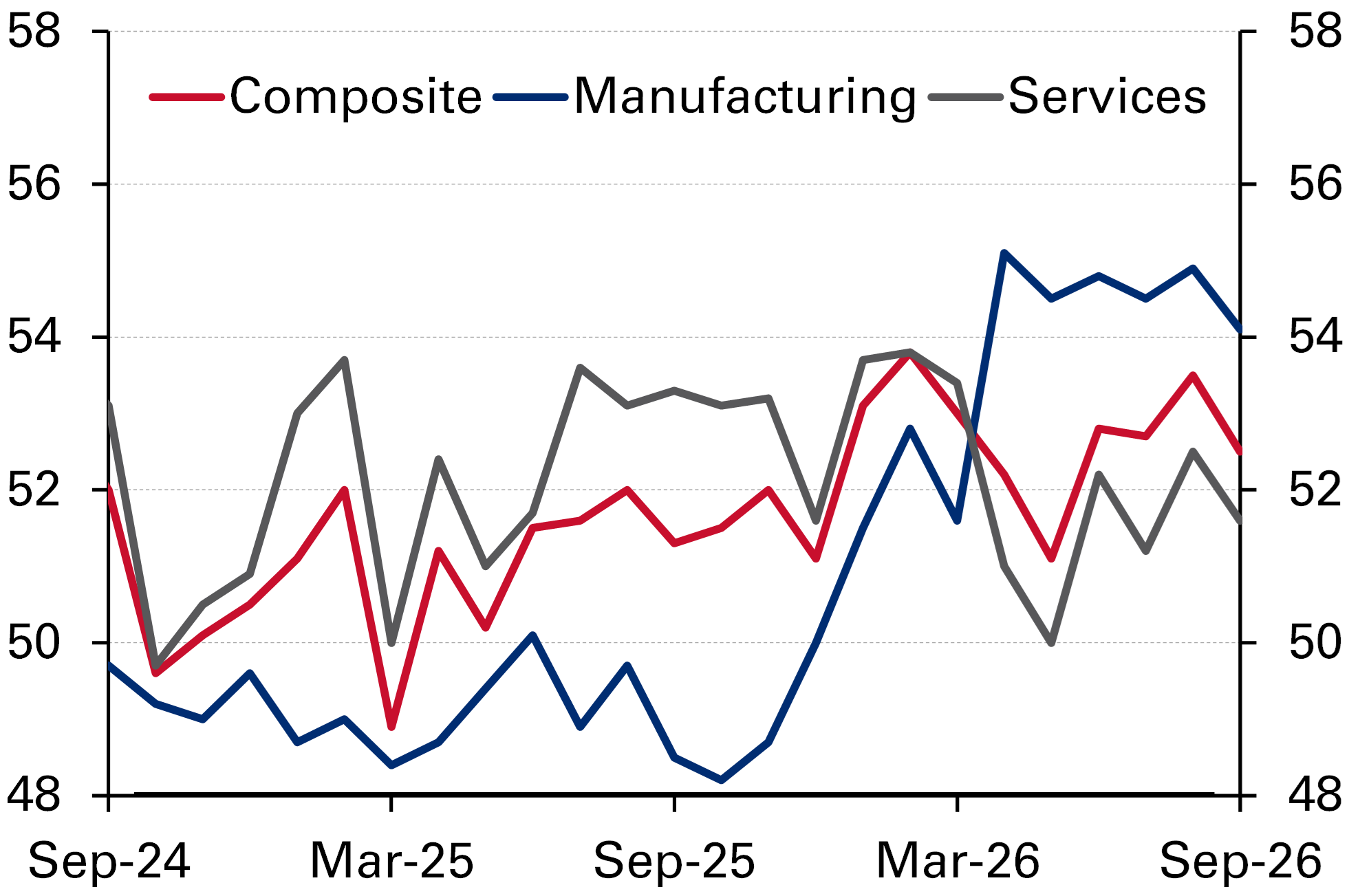
Japan: September flash PMI moderates as domestic demand cools, though external demand remained supportive. Japan’s flash composite PMI fell to 52.5 in September from 53.5 in August, marking a four-month low but remaining firmly in expansionary territory. The moderation reflected slower growth in both manufacturing and services activity, with the manufacturing PMI easing to 54.1 in September from 54.9 in August and the services PMI slipping to 51.6 from 52.5. The survey indicated that output and new business continued to increase across the private sector, albeit at a slower pace than in previous months, suggesting some loss of momentum in domestic demand. In contrast, overseas demand remained a bright spot, with export orders maintaining the strong pace recorded in August, supported by the manufacturing sector. Moreover, hiring remained robust, and business sentiment strengthened on expectations of continued demand in technology-related sectors. That said, it is worth noting that although inflationary pressures eased somewhat from August, they remained elevated, suggesting that growth momentum heading into Q4 continues to be accompanied by cost pressures.