
 +965 2292 4888


Daily Economic Update
03.11.2026
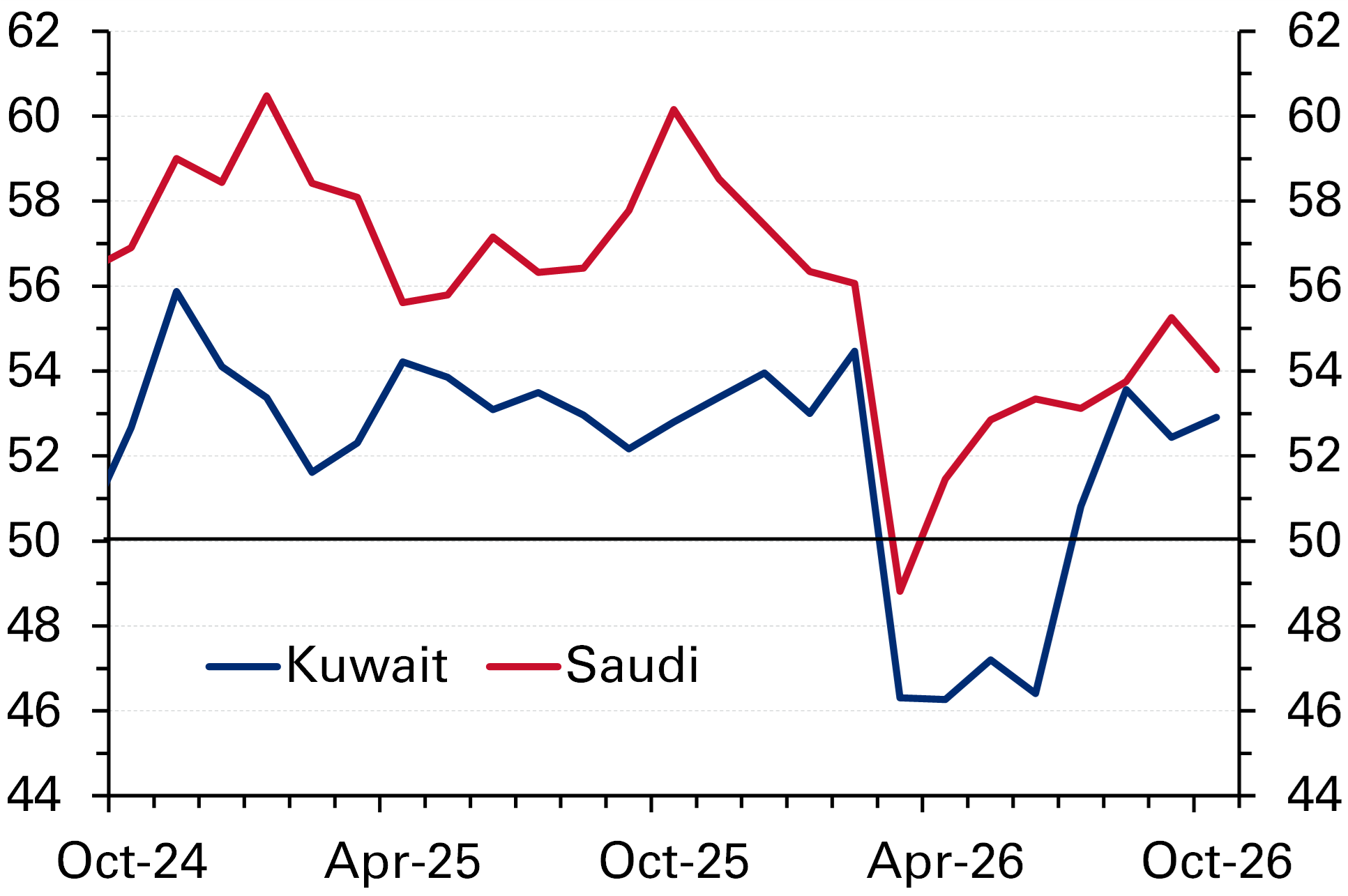
Kuwait: Business activity continued to strengthen in October, extending the third-quarter recovery. The non-oil private sector PMI rose to 52.9 from 52.4 in September, marking a fourth consecutive month of expansion and reflecting a further improvement in business conditions. Growth in output and new orders accelerated at the strongest pace since August and February, respectively, supported by new products, marketing efforts, competitive pricing, and stronger demand from both domestic and regional customers. Firms responded by increasing purchasing activity and inventory stocks at record rates, in part due to improved business confidence but also reflecting an effort to stock up ahead of expectedly higher future prices, according to some survey respondents. Meanwhile supplier delivery times improved to the best on record amid reportedly greater competition among suppliers and increased availability of materials. However, employment growth remained modest, leading to a further rise in backlogs of work due to staff shortages. Meanwhile, input costs rose for the sixth consecutive month and at the fastest rate since February, driven by significant increases in purchasing and staff costs, with companies passing higher costs to customers through higher selling prices. In fact, the output price balance rose to its highest since 2021. Looking ahead, businesses were mostly optimistic, with confidence reaching its highest level since February, supported by expectations of stronger demand over the coming year. Overall, the PMI suggests that the recovery from the activity weakness seen earlier in 2026 is being consolidated. The October score sat above the average for Q3 (52.3), suggesting a positive start to Q4.
Saudi Arabia: Non-oil private sector continued to expand in October, but cost pressures intensify. Saudi Arabia’s non-oil private sector continued to expand in October, although growth slowed, with the PMI easing to 54 from 55.3 in September. The index remained comfortably above the neutral 50 mark for the seventh consecutive month and recorded its second-highest reading since February, signaling continued resilience in the non-oil economy. Output growth picked up from September, while new orders continued to increase strongly, supported mainly by domestic demand. However, weaker external trade conditions weighed on export sales, which declined at a faster pace amid shipping disruptions, higher freight and insurance costs, and increased competition. Supply chains also remained under pressure, with supplier delivery times improving only marginally. Some firms responded by sourcing more inputs locally. Employment increased for the fourth consecutive month, although job creation remained modest and slowed from September. Purchasing activity also rose strongly as businesses built up inventories to guard against potential supply disruptions. Meanwhile, cost pressures intensified, driven by higher freight, insurance, raw material and energy costs. Staff costs recorded their fastest increase since February. However, output price inflation eased to a nine-month low as stronger competition encouraged firms to offer greater discounts, suggesting more limited near-term pressure on consumer prices. Looking ahead, business confidence remained mildly positive but below its historical average, reflecting continued geopolitical uncertainty and concerns over the operating environment.
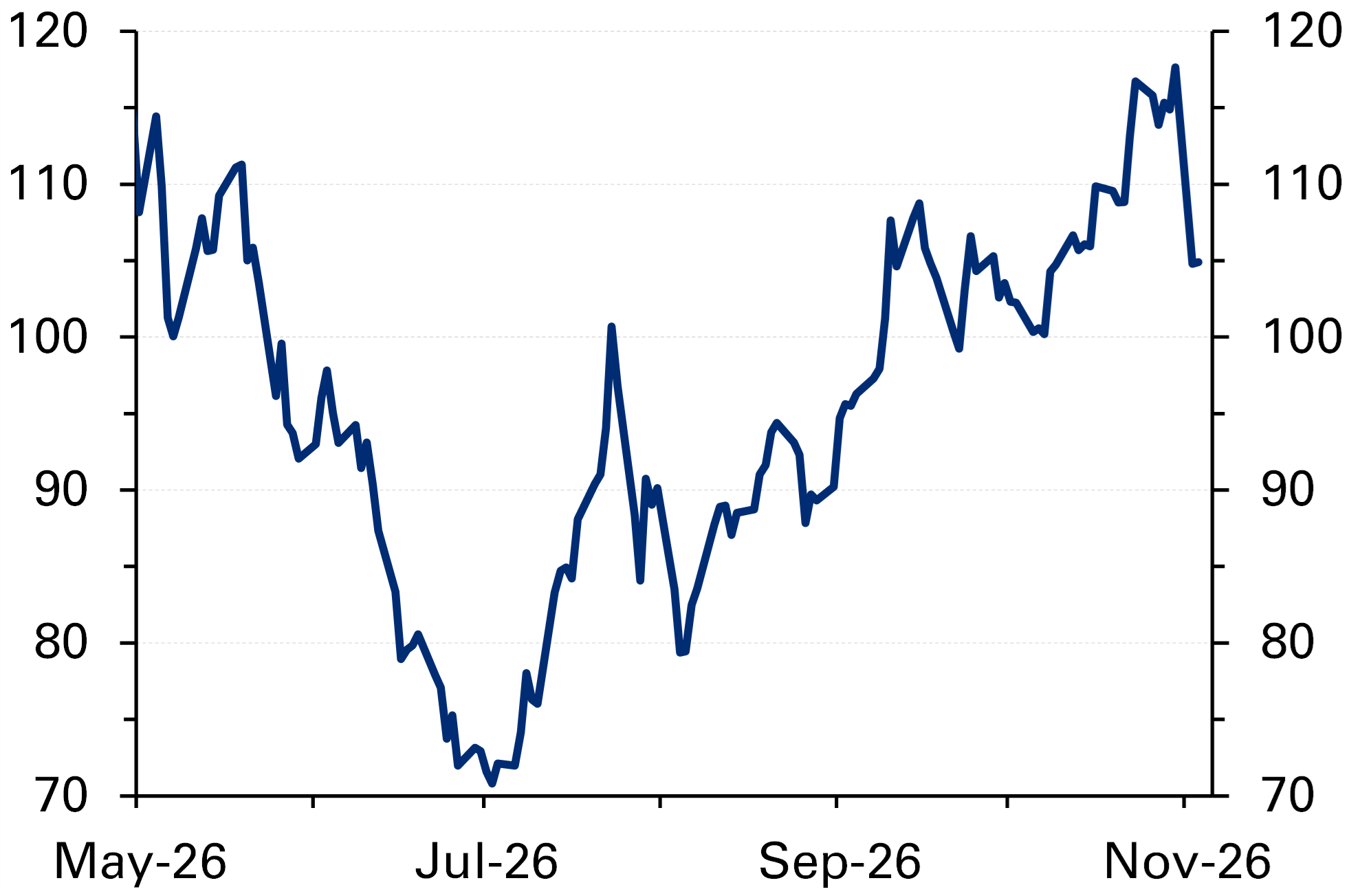
Oil: Prices slide amid heightened US-Iran deal optimism. Brent futures (January contract) plunged by 7.6% yesterday to $104.8/bbl as markets absorbed the possibility of a diplomatic resolution to the US-Iran conflict, unwinding part of the geopolitical risk premium that had accumulated in recent weeks ahead of the US mid-term elections. The latest rhetoric from both sides has taken a notably more conciliatory tone. Iranian President Pezeshkian stated that Supreme Leader Mojtaba Khamenei has granted the government more authority to negotiate, while US President Trump dismissed the prospect of imminent military action when asked whether he would strike Iran after the elections. US Vice President JD Vance also struck an optimistic tone, stating that both he and President Trump "feel good" about the prospects for a negotiated settlement. Meanwhile, momentum toward negotiations has also been supported by continued Qatari mediation efforts. The Qataris were back in Tehran yesterday, with media reports suggesting that the latest round of shuttle diplomacy helped achieve a breakthrough in discussions between the parties. Nevertheless, reports emerged overnight that the US had struck targets on Qeshm Island, highlighting the fragility of the current diplomatic momentum. Despite these reports, the market’s reaction has been muted so far, with Brent trading broadly unchanged at around $104.9/bbl at the time of writing.
UAE: ADNOC approves a landmark unconventional gas project. Abu Dhabi National Oil Company (ADNOC) announced that it has taken the Final Investment Decision (FID) on the Ruwais Diyab Unconventional Gas Development, marking the company’s first large-scale unconventional gas project. ADNOC has not disclosed the capital cost of the project as part of the FID announcement, though it is expected to deliver 345 million standard cubic feet per day (mmscf/d) of gas from 2029 over a 25-year period with a scope of increasing production further to 1000 mmscf/d over time. Gas will be processed on site and connected to the country’s national gas network through a new pipeline infrastructure. This project underscores the UAE’s efforts to unlock more of its gas and especially its unconventional gas reserves (e.g. from shale deposits), assessed at 298 trillion cubic feet and 160 trillion cubic feet, respectively. The additional volumes would help ADNOC meet rising demand, including power generation associated with expanding industrial activity and AI-related infrastructure. The project comes as part of ADNOC’s wider gas expansion strategy that includes the Hail & Ghasha offshore sour gas development (1,500 mmscf/d by 2030), the Umm Shaif Gas Cap project (550 mmscf/d by 2030), the rich gas development program that would add about 1,500 mmscf/d of processing capacity, and the 9.6 mtpa Ruwais LNG project that would expand the UAE’s LNG export capacity.
Egypt: Banque du Caire IPO marks major step in privatization program. Banque Misr sold 6.86bn shares, representing a 45% stake in Banque du Caire (BdC), for EGP 36.4bn (around $ 658mn). This marks the largest IPO on the Egyptian Exchange in at least a decade and the first state-owned company privatization through an IPO in two years. The proceeds will initially go to Banque Misr, BdC’s parent company, before being transferred to the Ministry of Finance. The ministry is expected to receive up to half of the proceeds and use them to ease public debt pressures. This follows a cabinet decision allowing the ministry to receive up to 50% of proceeds from the government’s broader privatization program. The sale represents an important step in the government’s efforts to reduce public debt without incurring additional interest costs, while relying less on traditional borrowing to meet its financing needs.
US: ISM manufacturing PMI climbs higher on surging production, but price pressures elevated. The ISM manufacturing index rose more than forecast to 55.5 in October from 54.5 in September, marking the 10th straight month of growth in manufacturing activity. While production surged to hit a nearly five-year high of 59 (56.7 in September), new orders also increased at a slightly faster pace (55.5 versus 55.3). The gauge of employment remained above the 50-neutral mark for the fourth consecutive month at 52.4 (52.7 in September). However, tempering the mood, firms cited elevated price pressures including from energy goods and other raw materials, as the input price measure stood sharply elevated versus its pre-war level at 75.2 albeit easing from September’s 77.9. Manufacturing activity, in recent months, has benefited from massive tech/AI-related investments and increased defense spending as well as some stockpiling efforts due to geopolitical uncertainty, helping keep US economic growth solid.
US: 10Y bond yields ease further on AI funding concerns and falling oil prices. Amid shifting expectations about the sustainability of the massive AI investment boom and related funding requirements, and helped by the latest decline in oil prices, the UST 10Y bond yield fell further to around 4.9% yesterday, hitting the lowest level since the second week of September, which should help ease some pressure on the US Treasury department. In fact, the Treasury will be announcing the size of its bond/bill auctions tomorrow, and there is some speculation that there will be cuts in auction sizes at the long-end of the curve and more issuance of short-dated instruments, aiming to push long-tern yields lower. Fresh concerns about AI spending also drove the US equity market lower, with the Nasdaq 100 falling for the third straight day and now down around 9% from its record-high in early October.
Download Full Report >