
 +965 2292 4888


Daily Economic Update
04.01.2026
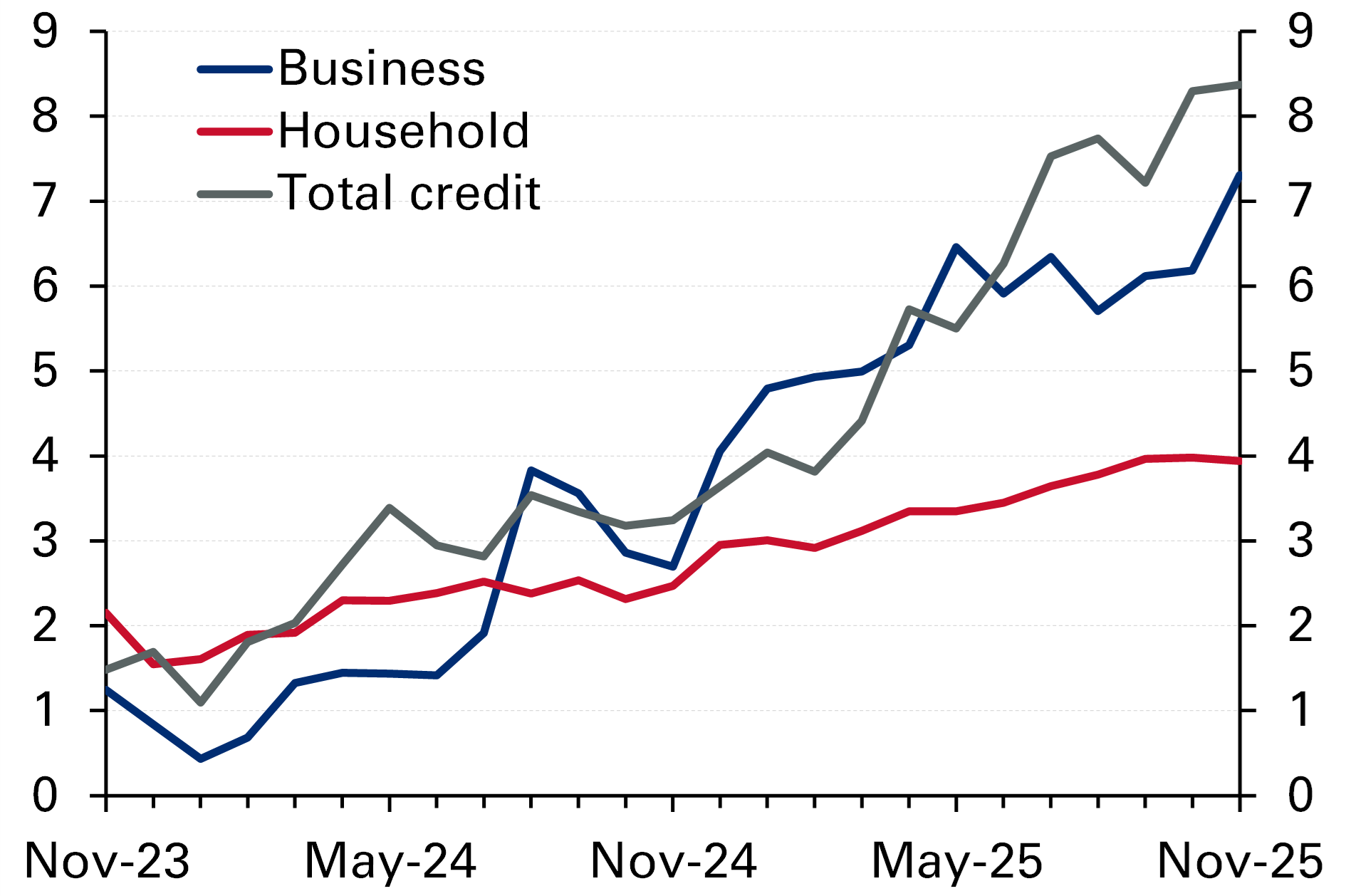
Kuwait: Business credit growth continued to power ahead in November. Recently released data showed that domestic credit increased by 0.3% in November, resulting in YTD growth of 7.8% and pushing up year-on-year growth to a three-year high of 8.4% from 8.3% in October. While headline growth continues to be volatile, and was on the weak side in November, underlying growth remains solid and steady. Business credit increased by a strong 1.1% in November, driving up YTD growth to 6.8% (7.3% y/y). Growth in November was driven by a solid increase in three sectors: oil/gas (+7.6% m/m), other services (+3.3%), and industry (+3.2%). On a YTD basis, other services (+14%) and industry (+11%) are in the lead and by a wide margin. Household credit increased by 0.2% m/m, the slowest growth in five months, pushing the YTD increase to 3.7% (3.9% y/y). Meanwhile, resident deposits increased by 0.8% m/m in November driven by another jump in the volatile public-sector deposits while private sector deposits inched up by 0.1%. On a YTD basis, resident deposits are up by 4.3%, dragged down by a 19% fall in government deposits while private-sector and public-sector deposits increased by 3.6% and 26%, respectively.
Bahrain: New fiscal measures planned from 2026 to bolster public finances. The Bahraini authorities announced last week new measures to come into effect from 2026 to help strengthen the kingdom’s public finances. The new reforms include: applying a 10% corporate income tax on local firms generating annual revenues of more than BD1 million ($2.6 million) or profits of more than BD200,000; increasing the dividend due to the central government from state-owned companies (expected in 2027); raising fuel, water and electricity prices (except for certain tariff bands) and natural gas prices for businesses; increasing fees for worker permits and healthcare services; introducing a monthly fee on undeveloped investment land (starting at 100 fils per square meter); and reducing government administrative spending by 20%. The measures, which are in-line with Bahrain’s Economic Vision 2030 strategy, are intended to raise non-oil revenues and bring public spending down onto a more sustainable trajectory. With serially high fiscal deficits (-7.7% of GDP forecast for 2025) and public debt levels (gross) that are heading towards 135% of GDP – on both counts the highest in the GCC – Bahrain is looking to make the fiscal adjustments necessary to prosper in an era of lower oil prices. The IMF has pressed on the authorities to enact fiscal and structural reforms to improve the public finances, while the kingdom’s sovereign rating was downgraded recently by S&P to B from B+.
Qatar: Economic growth quickens in Q3 2025. GDP expanded by 2.9% y/y in Q3 2025, accelerating from 1.9% in the previous quarter, helped by an improvement in non-hydrocarbon activities and a stabilization in hydrocarbon GDP. The non-hydrocarbon economy grew by 4.4% y/y, picking up from 3.4% in Q2 on output gains in the construction (9.1% y/y), wholesale & retail trade (8.9%), public administration (5.8%), and transportation (5.5%) sectors especially. The information and communication sector also returned to growth following steep declines in the previous two quarters. Meanwhile, growth in the restaurants & hotels and recreation categories softened markedly, though growth here is poised to see a pick-up in Q4 due to increased tourist arrivals from the FIFA Arab Cup. Looking at the natural gas-dominant hydrocarbon sector (mining & quarrying), growth returned in Q3, albeit at a modest 0.1% y/y, after the contraction recorded in Q2 (-0.9%). Over 9M 2025, non-hydrocarbon GDP growth averaged 5%, and is on track to exceed the government’s full year target of 4% (and our forecast of 3.5%) thanks to better-than-expected construction and wholesale/retail trade activity. This could push the share of non-hydrocarbon activities in the total economy to a record high of 65.5% (in 2018 prices).
China: President Xi declares that economic targets for 2025 have been achieved; December’s PMI stronger than expected. Addressing the country’s top political advisory body on New Year’s Eve, President Xi mentioned that China is set to meet its economic targets for 2025, with growth expected to reach around 5%, stating that “we have successfully achieved our main economic and social development targets.” On the data front, the official manufacturing PMI rebounded to a higher-than-expected 50.1 in December, up from 49.2 in November, marking a return to expansion after eight consecutive months of contraction. The upturn was broad-based with new orders rising to 50.8. The non-manufacturing PMI climbed to 50.2 in December from 49.5 in November, mostly driven by the construction component, which jumped to 52.8 from 49.6. The composite PMI edged up to 50.7 in December 2025 from 49.7 in November, the highest level since June. This data offers policymakers some reprieve after opting to close out 2025 without significant new stimulus while likely still aiming for an around 5% growth target for 2026.
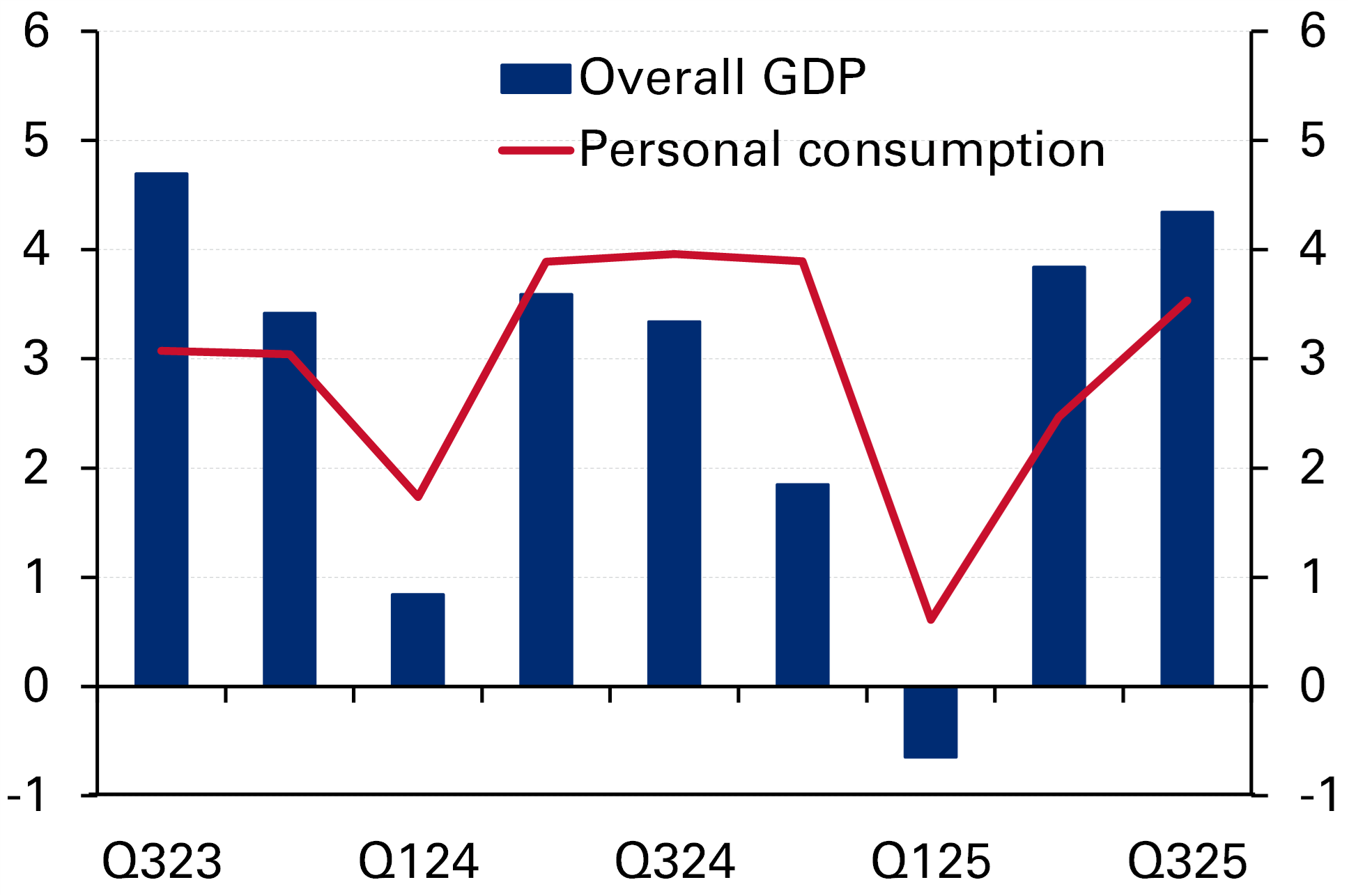
US: Solid and higher-than-expected GDP growth in Q3 while jobless claims remain low. Previously reported data showed that the US economy grew by a forecast-busting 4.3% q/q (annualized) in Q3, accelerating from 3.8% in Q2 on a solid rise in household spending (3.5% versus Q2’s 2.5%) and robust business investment in AI/technology while the contribution from net exports was also favorable. Indicating solid underlying growth, final sales to private domestic purchasers (which excludes government and trade contributions) rose by 3% from 2.9% in Q2, a four-quarter high. GDP growth in Q4 will be temporarily suppressed by the record-long government shutdown in October-November, but the outlook for 2026 is strong for now. Meanwhile, initial weekly jobless claims (w/e December 27) dropped to a four-week low of 199K from 215K the previous week, while continuing claims also fell to 1.87 million (w/e December 20) from 1.91 million the week before. Though jobless claims tend to be volatile during the final few weeks of the year, the broader trend indicates that firings remain modest but also that finding a new job is not easy. The US economy has added just a net 17K jobs on average per month since May 2025, which along with moderate unemployment further underlines a current low-hire and low-fire job scene. Meanwhile, the minutes from the December 9-10 FOMC meeting showed nervousness among officials about the pace of interest rate cuts, and a few who supported the rate cut in December believed “that the decision was finely balanced or that they could have supported keeping the target range unchanged.” Meanwhile, some saw “it would likely be appropriate to keep the target range unchanged for some time after a lowering of the range at this meeting,” but at the same time “most participants noted that a move toward a more neutral policy stance would help forestall the possibility of a major deterioration in labor market conditions”. More recently, Philadelphia Fed President Anna Paulson (a voting member in 2026) stated that “some modest further adjustments to the funds rate would likely be appropriate later in the year,” seeing “inflation moderating, the labor market stabilizing and growth coming in around 2% this year.” We note that the latest dot-plot shows only one more 25 bps interest rate cut in 2026, but the futures market continues to signal two to three cuts by the end of 2026.