
 +965 2292 4888


Daily Economic Update
05.11.2026
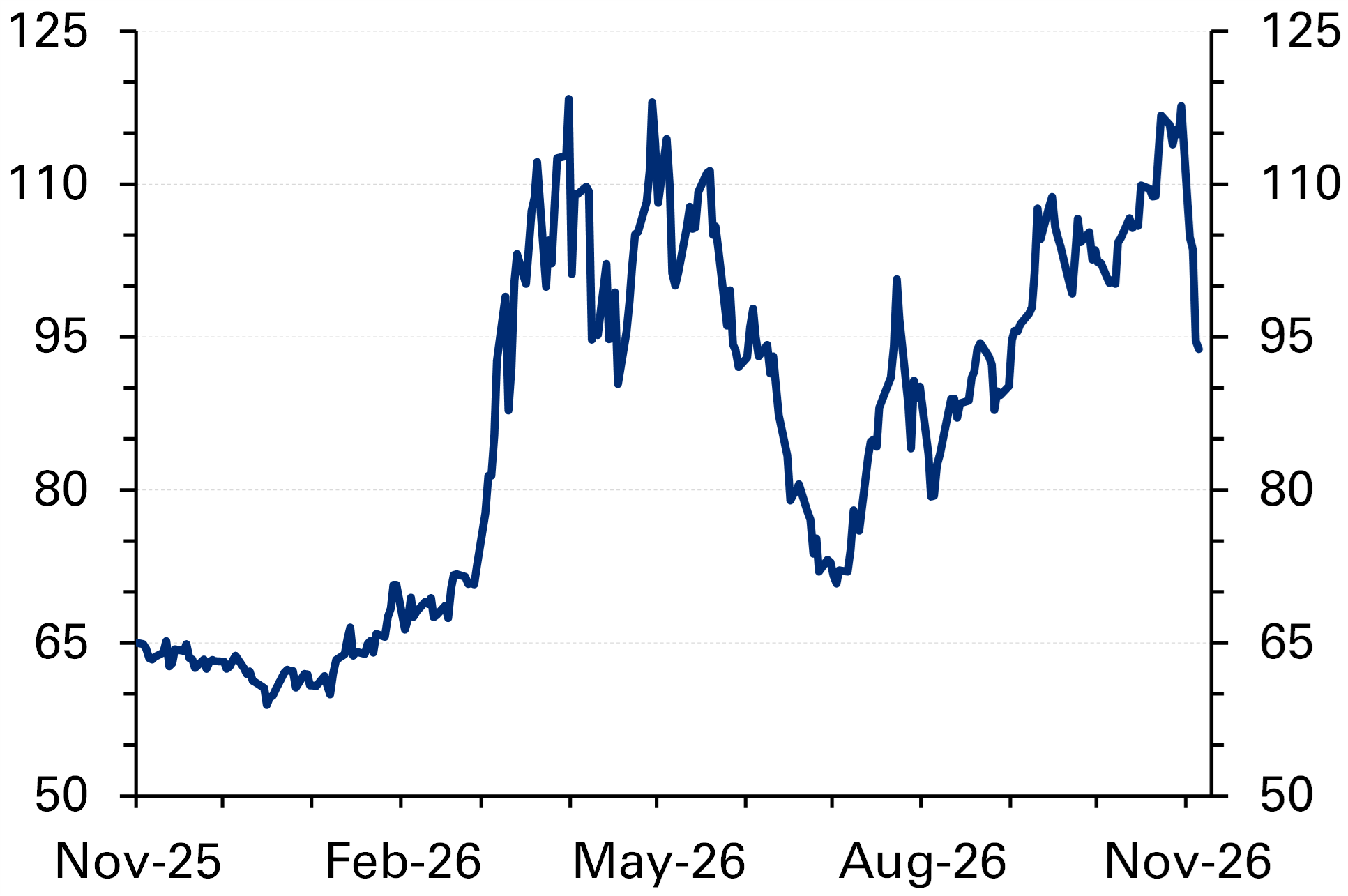
Oil: Brent falls below $100/bbl as the US-Iran war risk premium erodes. Brent futures plunged by 8.7% yesterday and extended losses by a further 1% in early Asian trading today to $93.8/bbl as the outcome of the US mid-term elections prompted a rapid unwind of the geopolitical risk premium that had supported prices in recent weeks. Markets had increasingly priced in the possibility of a US-Israeli strike on Iran during the election period, helping push Brent above $115/bbl prior to the vote. However, signs of a diplomatic path forward, coupled with repeated messaging from the US administration that it was not seeking a large-scale military campaign, had already begun to erode those expectations. Election results further accelerated the selloff as Democrats won control of both chambers of Congress, which is viewed as a setback for President Trump's foreign policy agenda, potentially limiting the administration's room to expand military operations against Iran through greater congressional influence over spending and oversight. Additional pressure came from comments by US Vice President JD Vance, who linked the election outcome in part to public dissatisfaction with the Iran conflict. Taken together, developments have strengthened market expectations that Washington may pursue a more measured approach toward Iran, reducing fears of an imminent escalation and prompting a sharp reassessment of oil’s risk premium.
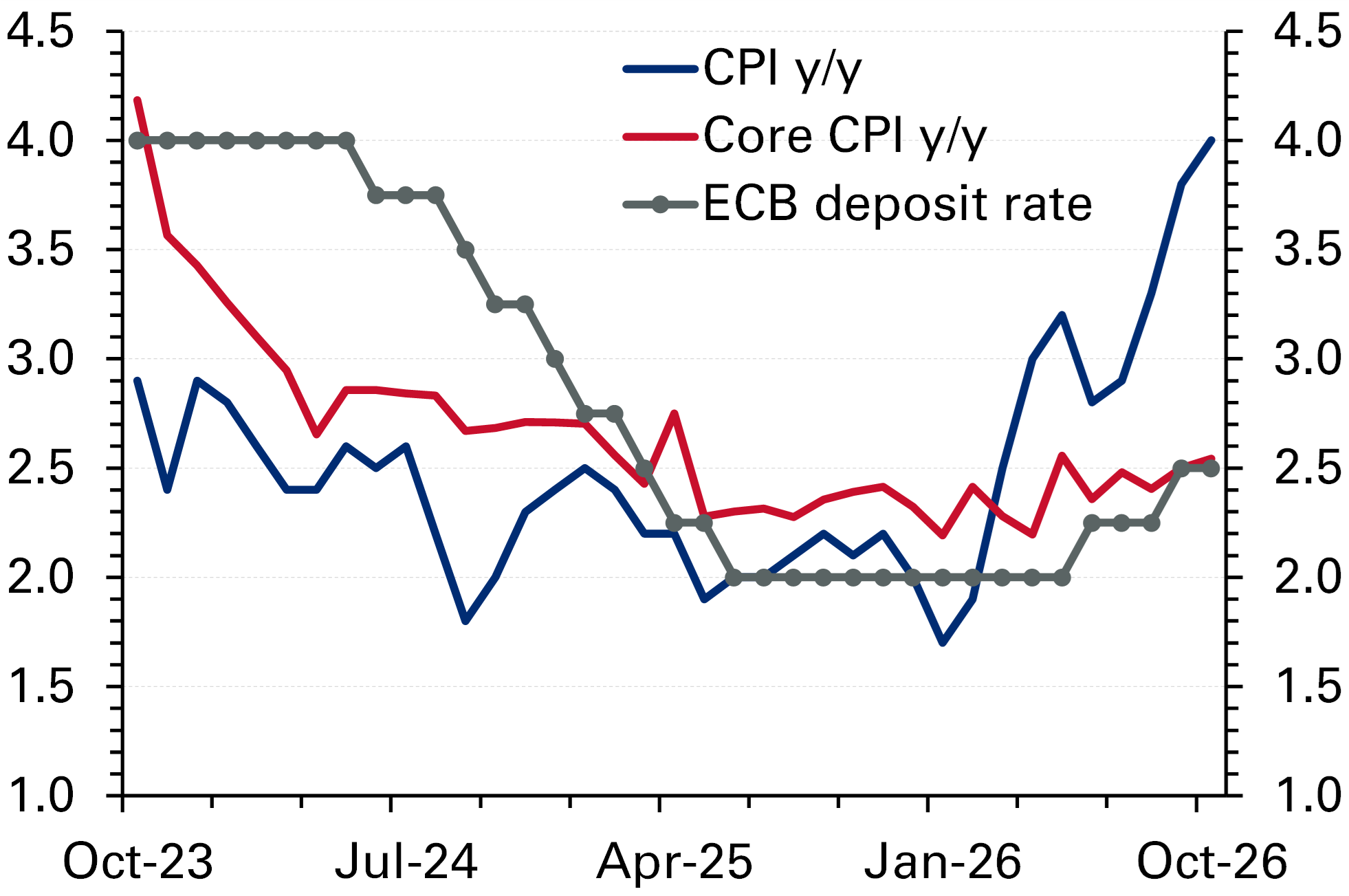
Eurozone: Flash CPI inflation in October rises but core holds steady matching expectations. Eurozone flash CPI inflation further hit an over three-year high of 4% y/y in October from September’s 3.8%, primarily driven by a 21% y/y surge in energy costs. The core rate, however, held steady at 2.5% but services inflation accelerated to a three-month high of 3.3% from 3.2% in September. After lifting policy interest rates twice since June, the ECB maintained them at its end-October meeting, highlighting that underlying inflation was broadly stable with no significant second-round effects yet seen on wage growth from rising energy prices but warned that they continued to pose upside risks to inflation. The latest CPI prints point further in that direction. In the post-meeting conference, ECB President Lagarde had emphasized that the bank’s Governing Council had debated whether a further rate hike was warranted before unanimously deciding to hold rates steady in October, a message interpreted by markets as a relatively hawkish pause. Therefore, the futures market, which was already pricing-in a strong possibility of another 25bps rate hike in December, now signals around a 60% probability for the same.
US: Growth in services activity eases but still robust; markets cheer divided government outcome amid prospects of greater policy oversight. The ISM services PMI edged down slightly below forecast to 54.5 in October from September’s 54.9 on a softening in the new orders (to 55.9 from 59.8) and output components. But reflecting the current robustness in services activity, the PMI has averaged 54.5 this year, up from an average of 51.7 in 2025. Growth in employment picked up, with the gauge hitting an eight-month high of 51.4 from 50.1. However, cost pressures remained sharply elevated, as the input price measure fell marginally to 73 from September’s 50-month high of 74, with tariffs and energy costs continuing to be businesses’ key concerns, raising the risk of their further transmission to consumer prices. Still, the US economy has remained exceptionally resilient over the past several quarters helped by AI-linked investments and robust household consumption despite higher inflation and government policy turmoil, and the latest activity indicators signal the continuation of that trend for now. Separately, the US Treasury Department, in its latest quarterly refunding statement, slightly tweaked the guidance language, saying it expected to keep auction sizes for notes and bonds unchanged “for the next several quarters”, and removed the phrase “at least” in describing the timeframe. Prior to the announcement, some market participants had speculated that Treasury may explicitly guide to cut auction sizes for the longer tenor UST bonds over the coming periods, given the steep rise in yields on those bonds recently. However, market moves were more dictated by the prospects of greater policy oversight, the removal of election uncertainty and an increasing likelihood of no major erratic policymaking following the Democratic sweep in the congressional mid-term elections that also weighed heavily on oil prices. The S&P 500 index jumped by around 1.6% on Wednesday, recovering from a steep 1-2% drop seen in premarket yesterday morning, while 10Y UST bond yields fell by over 5bps.
UAE: ADNOC highlights energy security, resilience, and AI partnerships at ADIPEC 2026. Abu Dhabi National Oil Company (ADNOC) used its hosting of Abu Dhabi International Petroleum Exhibition and Conference in 2026 to reinforce its position as a leading energy supplier amid heightened geopolitical and supply chain risks. During the opening session, Dr Sultan Ahmed Al Jaber, UAE Minister of Industry and Advanced Technology and Managing Director and Group CEO of ADNOC, warned that global energy markets had seen a significant erosion of supply buffers following disruptions to energy trade routes, noting that nearly one billion barrels of crude oil had been drawn from inventories and that logistics costs had increased substantially as a share of oil prices. He emphasized that energy security should now be measured not only by production capacity but also by the ability to ensure reliable delivery to end markets. ADNOC outlined five priorities for a resilient energy system, including expanding strategic reserves, strengthening infrastructure, deploying advanced technologies, improving financing frameworks, and investing in human capital. In a major strategic announcement, the company unveiled large investments including an AED200 billion ($55 billion) energy and industrial project award program for 2026-28, covering both upstream and downstream projects across ADNOC's value chain and localization initiatives under ADNOC's In-Country Value program. Other key announcements included the final investment decision of the Ruwais Diyab unconventional gas development and a strategic AI partnership with OpenAI and G42 to deploy OpenAI Frontier technology across its operations.
Download Full Report >