
 +965 2292 4888


Daily Economic Update
09.11.2026
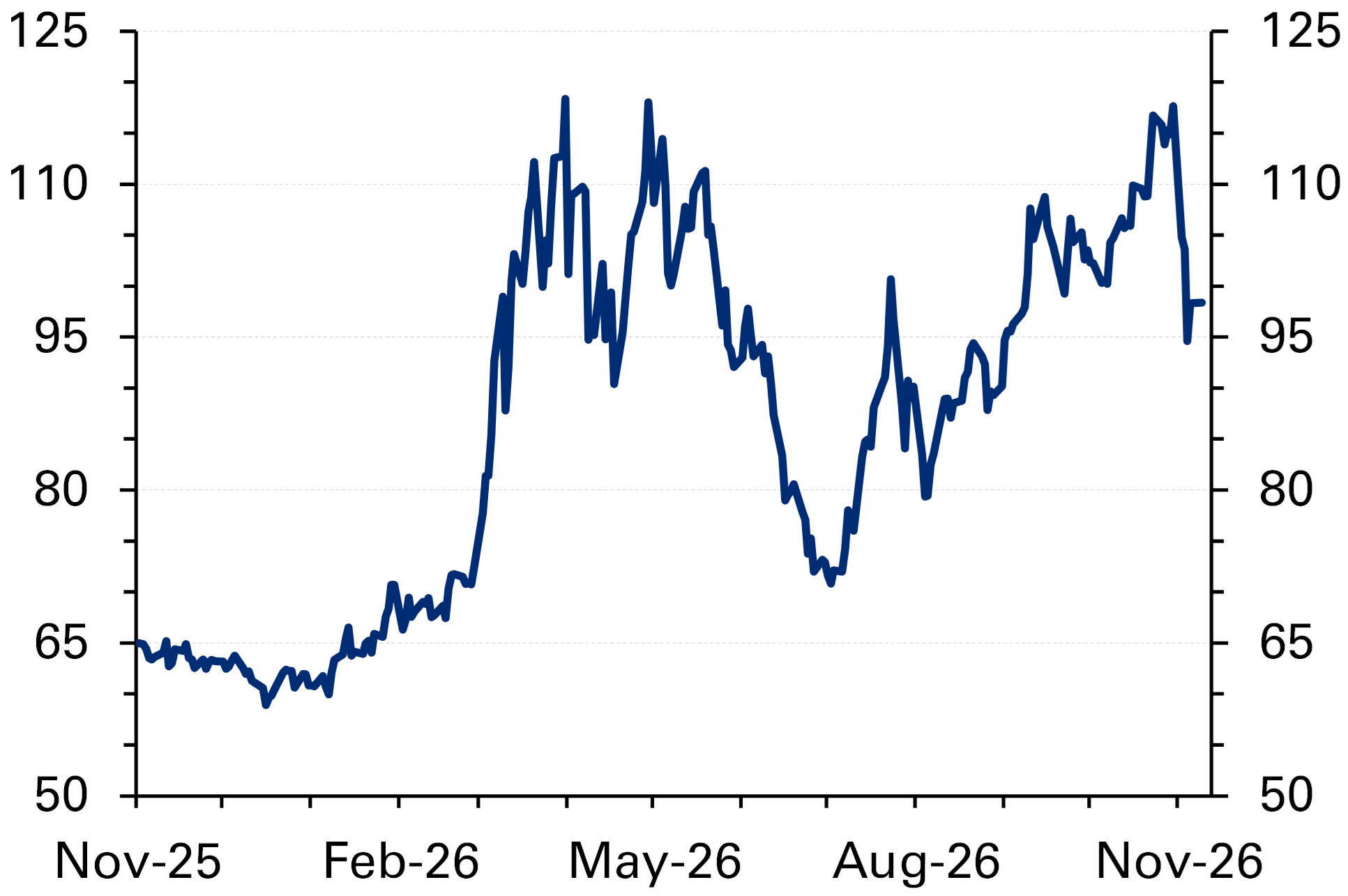
Oil: Prices recorded steep weekly declines on diplomatic overtures, easing physical premiums. Oil prices fell sharply last week, with Brent futures closing Friday at $98.3/bbl, down 16.4% w/w, marking the largest weekly decline since April 2020 at the height of the Covid-19 pandemic. Prices were little changed this morning in Asian markets, with Singapore on a public holiday. Last week’s selloff was driven primarily by a sharp unwinding of the geopolitical risk premium amid intensive shuttle diplomacy, especially by the Qataris, to bridge the divide between the US and Iranian negotiating positions and as fears of an imminent US strike on Iran appeared to recede in the wake of the US mid-term results. The resounding Democrat victory, in which they took control of both chambers of Congress, is seen as increasing checks on the White House's ability to pursue further military escalation, as well as underlining a lack of public support for such a move. Moreover, the physical crude market is also signaling less tightness, with prices also falling and premiums to futures prices narrowing substantially as Gulf exports continue to inch closer to pre-conflict levels. Despite improving optimism surrounding a potential US-Iran agreement, the "no-war, no-peace" environment appears likely to persist in the near term, especially as both sides’ demands remain far apart. Indeed, while Iran continues to insist that Washington address its “seven conditions” before any agreement can be reached, comments from the US Secretary of State describing Tehran’s demands as “outrageous and ridiculous” underline the significant gap that remains between the two sides. Meanwhile, continued attacks on shipping in the Strait of Hormuz and US strikes on Qeshm Island helped prices recover some ground towards the end of last week. Tight market balances also remain supported by inventory drawdowns: EIA weekly data showed US crude stocks falling 1.3 mb w/w in the week ending 30 October, alongside a 400 kb decline in SPR inventories. Gasoline and diesel stocks also fell on a weekly basis by 222 kb and 3.6 mb, respectively. Attention this week will turn to monthly oil market reports from OPEC and the IEA, due on Wednesday and Friday, respectively.
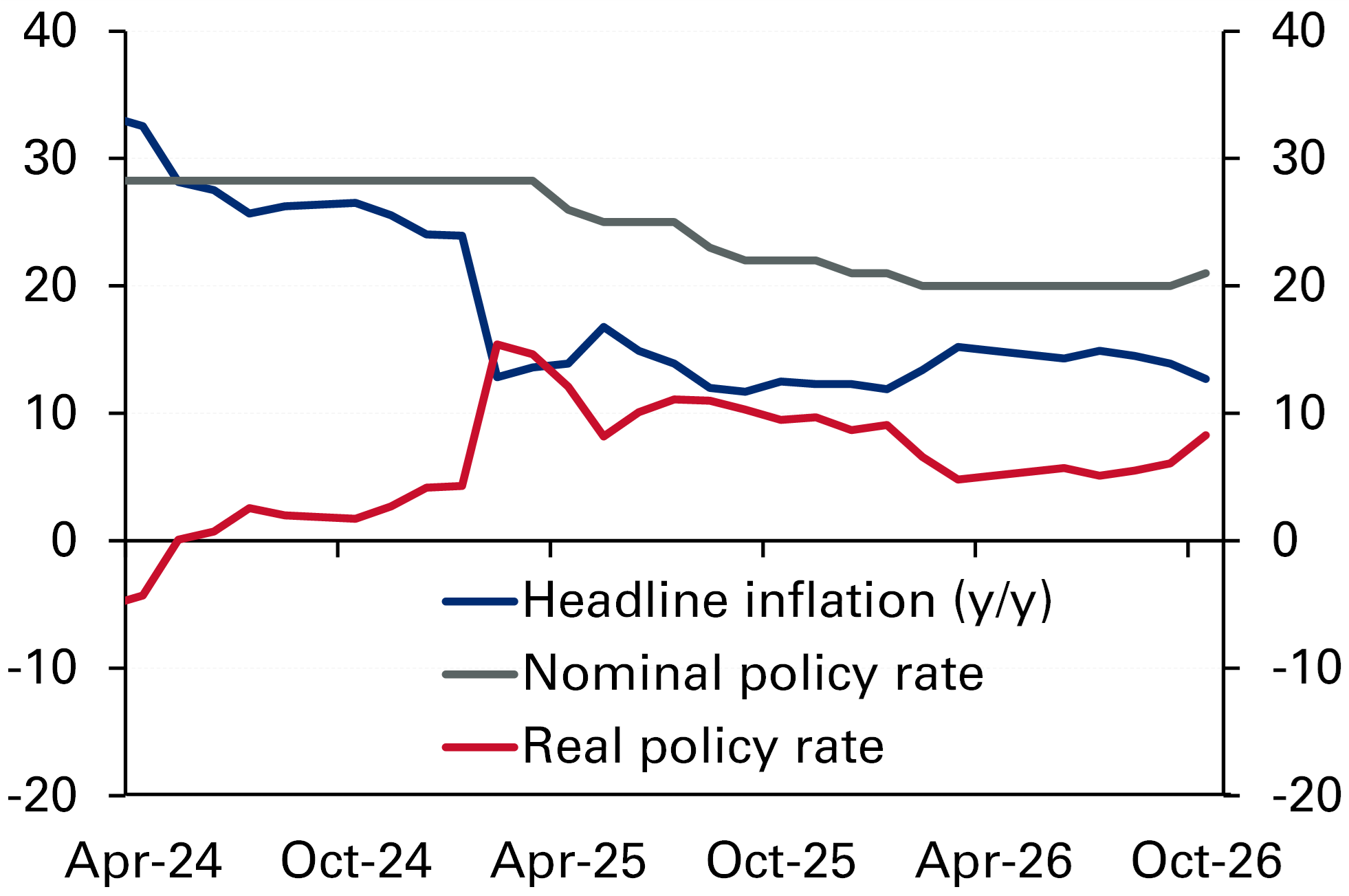
Egypt: Urban inflation falls to a nine-month low in October. The urban inflation rate eased for a third consecutive month, falling to 12.7% y/y in October from 13.9% in September, its lowest level in nine months, according to CAPMAS. On a monthly basis, inflation also slowed to 0.7% from 1.3% in September, despite a depreciation of more than 7% in the Egyptian pound during the month. The slower monthly increase was mainly driven by declines in fruit and vegetable prices, which fell by 2.9% and 2.6%, respectively. However, food price pressures persisted in some categories, particularly meat and poultry. The latest figures follow the central bank’s 100 bps interest rate hike in October, its first increase since March 2024, pushing the overnight lending rate to 21%. Hence, the real policy rate increased to around 8% in October. While the decline in annual inflation is encouraging, it does not mean that prices have fallen. Rather, consumer prices continued to rise in October, but at a slower pace than in the previous month.
Saudi Arabia: Construction growth slows as residential and commercial activity weakens. Saudi Arabia’s construction sector continued to expand in October for the sixth consecutive month, although growth slowed to its weakest pace since May. The Saudi Construction Index declined to 52.3 from 54.4 in September, remaining above the 50-point threshold that separates expansion from contraction. Business activity and new orders continued to increase, but at a slower pace. Infrastructure projects were the main driver of growth, with the infrastructure activity index rising sharply to 64.3 from 55.8 in September, its highest reading since the survey began in January 2026. In contrast, residential construction activity almost stagnated, with its index easing to 50.4, while non-residential construction, including commercial, office and industrial buildings, contracted for the first time since the survey began, with its index falling to 48.8. Surveyed companies attributed the weakness in non-residential construction partly to greater client caution and project delays amid regional instability. This comes as Houthi attacks on civilian targets in Saudi Arabia, including major airports in Riyadh and Dammam, have intensified. Overall, the figures suggest that infrastructure investment continues to support construction activity, but uncertainty is increasingly weighing on other segments of the sector.
China: CPI inflation remained muted in October as PPI inflation hit a more than four-year high on higher energy prices. CPI inflation softened to a lower-than-expected 0.7% y/y in October, down from 0.9% in September. The lower reading was mostly driven by a steeper drop in food prices (-2.9% y/y, from -1.7%), lower increases in clothing prices (1.1% versus 1.2%) and in healthcare (2.4% versus 2.7%). Non-food inflation was steady at 1.5% y/y despite an acceleration in transportation/communication prices (5.5% versus 4.3%) driven by higher fuel prices. Core inflation, which excludes food and energy, decelerated to 0.8% y/y from 1%, the lowest level since January. CPI inflation continues to be muted, with the headline rate remaining in a -1% to +1% range since early 2023, reflecting weak domestic demand. This is one reason keeping Chinese government bond yields under control with the 10-year yield at around 1.6%, sharply below developed market peers. And while yields in developed markets are up strongly YTD, the 10-year yield in China is down by around 25 bps. Meanwhile, producer prices surged by 5.7% y/y in October, up from 5% in September and easily beating expectations (5.3%). This was the fastest pace in more than four years. The acceleration was driven by higher energy prices, pushing up costs for factories. Specifically, the ‘producer goods’ category saw prices rally by 7.4% y/y, up from 6.5% in September.
Global: US October CPI inflation, UK Q3 GDP, and China October trade key data releases this week. In the US, CPI inflation (Tuesday) in October is seen edging down to 0.3% m/m for the headline rate and 0.2% for the core from September’s 0.6% and 0.3%, respectively. Similarly, PPI inflation (Friday) is expected to soften to 0.4% m/m in October after an outsized 1.3% reading in September. Fed speak will continue this week, particularly from the influential Williams and Jefferson at the end of the week, helping to shape market expectations around the December meeting rate decision. In the UK, Q3 GDP will be released on Thursday, and the consensus forecast is growth of 0.7% q/q versus 0.5% in Q2, indicating ongoing resilience despite a reacceleration in inflation. In China, October’s trade data is due on Tuesday where the trade balance is seen remaining in ample surplus, though narrowing slightly to around $127 billion from $134 billion in September. Finally in Japan, household spending for September (Tuesday) is seen falling by 3.1% y/y, in-line with the decrease recorded in August. On Thursday, PPI inflation for October is expected at 6.5% y/y, down from 6.8% in September.
Download Full Report >