
 +965 2292 4888


Daily Economic Update
23.09.2026
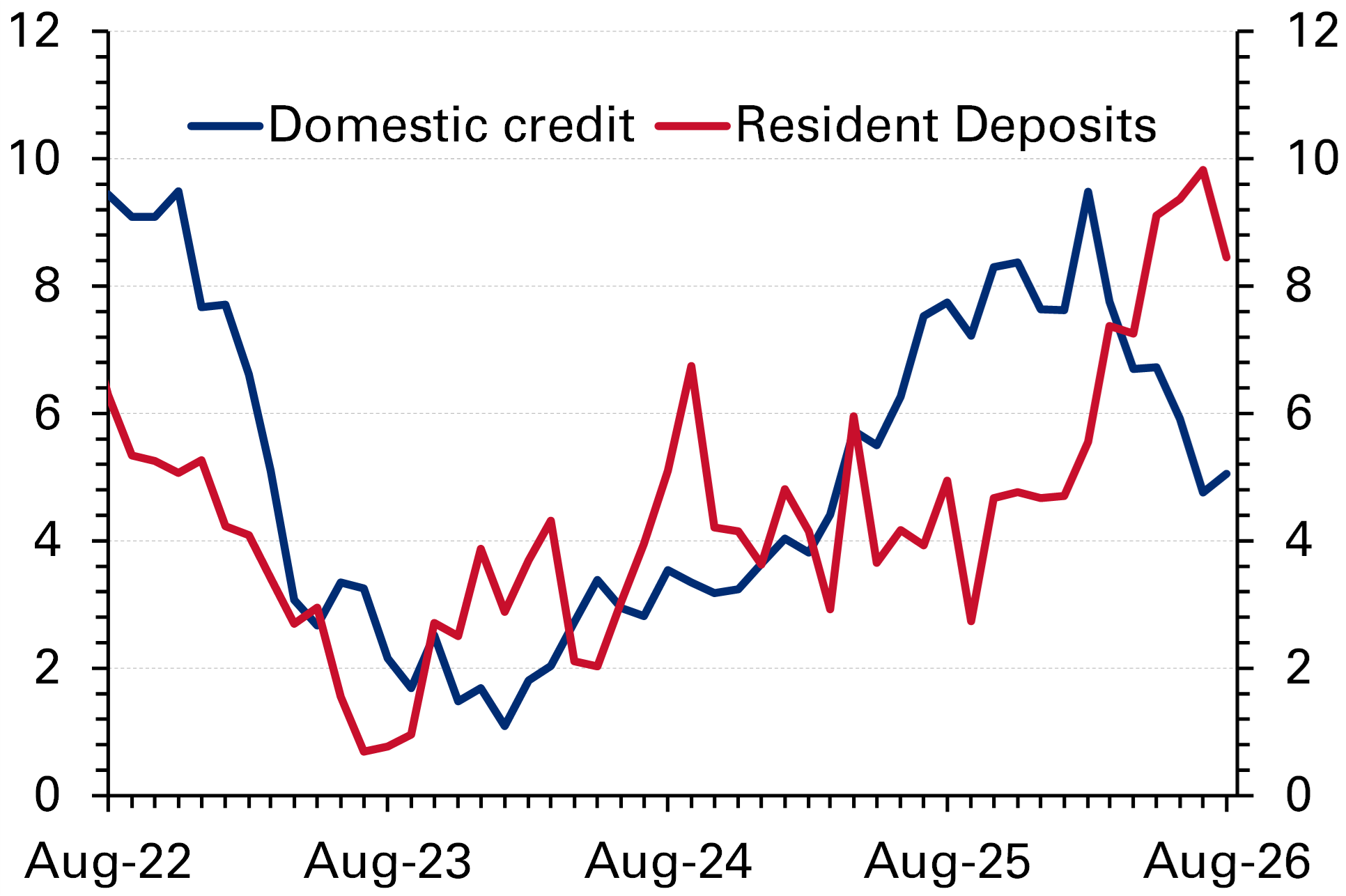
Kuwait: Domestic credit sees solid rise in August, led by lending to banks and financial institutions. Central Bank of Kuwait data for August showed that total domestic credit rose a solid 0.9% m/m after dipping 0.2% in July, pushing the y/y growth rate up to 5.1% from 4.8%. The increase was led by credit to banks and financial institutions (+8.8% m/m; -9.2% y/y), following a steep contraction in July, and higher household borrowing (+0.7% m/m; +4.7% y/y). Credit for the purchase of securities also returned to monthly growth (+1.0% m/m; +7.4% y/y) in August. Business credit, meanwhile, continued to expand at a decent pace, though growth moderated to 0.4% m/m (+6.6% y/y) on softer lending to the industrial (+0.3% m/m; +11% y/y) and construction sectors (+0.9% m/m; +7.3% y/y) as well as by a fall in credit to ‘other services’ (-0.9% m/m; +14.9% y/y). Meanwhile, credit to non-residents extended gains for a second consecutive month (+2.1% m/m), though annual growth continued to ease to 14.7% from its 2026 peak of 46% in April. On the liabilities side, residents’ deposits rose 0.7% m/m in August (+8.4% y/y), driven by a strong rise in public sector deposits (+4.4% m/m), which more than offset a slowdown in government deposits (+0.1% m/m) and a slight decline in private sector deposits (-0.1% m/m). On the other hand, non-resident deposits contracted by 2.7% m/m, the first drop since May, due to a decline in public institutions and government deposits. Overall, the figures continue to show credit growth holding up well given the economic pressures arising from the regional conflict, with both household and business lending growth as well as deposit growth higher than at the start of 2026 in year-on-year terms.
Saudi Arabia: Construction costs stable in August. Saudi Arabia’s Construction Cost Index (CCI) remained unchanged at 104 points in August, the same level recorded in both June and July. Despite the monthly stability, construction costs are up by 2.2% y/y in August. The annual increase was driven by higher costs in both the residential and non-residential sectors, which rose by 2.2% and 2.7%, respectively. In the residential sector, the increase was mainly due to a 1.8% rise in the cost of basic materials, driven by a 2.0% increase in metal product prices. Meanwhile, higher costs in the non-residential sector were largely attributed to a 5.8% increase in equipment and machinery rental costs.
Egypt: NBE moves to acquire Banque Misr’s UAE branches. The National Bank of Egypt (NBE) has received preliminary approval from the Central Bank of the UAE to acquire Banque Misr’s branches in the UAE, according to a joint statement by the two state-owned banks. The deal would consolidate their UAE operations under a single banking platform subject to UAE regulations. This follows the US Treasury Department’s Financial Crimes Enforcement Network move to restrict Banque Misr’s UAE branches to US correspondent banking, alleging that the branches moved around $1.8bn between January 2024 and June 2026 for 103 companies linked to Iranian shadow-banking networks. The US action applies only to Banque Misr’s UAE branches, with the bank’s Egypt operations and other overseas branches unaffected. The Central Bank of the UAE has also launched its own investigation into the branches.
UK: Government’s August borrowing tops official forecast, raising pressure on the Chancellor ahead of the Autumn budget. Public sector net borrowings came in at £18.3bn in August, above the official forecast of £14.8bn by the OBR for the month, taking total borrowings to £77.3bn in the first five months of the current fiscal year (ending March 2027), higher than the budgeted amount of £69.2bn for the same period. Higher-than-projected expenditures mainly drove the variance especially social and pension benefits along with greater interest outgoes during the April-August period. Borrowings overshooting the official projections along with elevated gilt yields will compound the challenges for Chancellor Healey ahead of the upcoming Autumn budget on October 28, who likely will be more hard-pressed to find savings to avoid unsettling the UK gilt market.
US: More FOMC members express concern about above-target inflation. Richmond Fed President Tom Barkin (a non-voting member in 2026) believed that current inflationary shocks “may pass in time” but would take longer, adding being “open to the possibility that inflation could come back down in short order.” He was less committed about future interest rate hikes versus other FOMC members, saying, “will additional hikes be required, and how many? We’ll see.” He also noted that the economy wasn’t overheating “with the exception of AI, which is quite heated.” His colleague, Boston Fed President Susan Collins (non-voting member in 2026), also sounded cautious, mentioning that there was an increased likelihood of inflation staying notably above the 2% target. She expressed that “a somewhat more restrictive federal funds rate will help ensure that inflation durably returns to target,” as her projection was in line with the median projection about the policy rate path ahead, seeing another rate hike in 2026 and holding steady in 2027. Amid a relatively stable job market, FOMC members have become more wary of the stubbornly elevated inflation that has stayed above the Fed’s 2% target for over five years now, as repeated supply shocks have impeded the disinflation progress, signaling further policy tightening over the coming months.
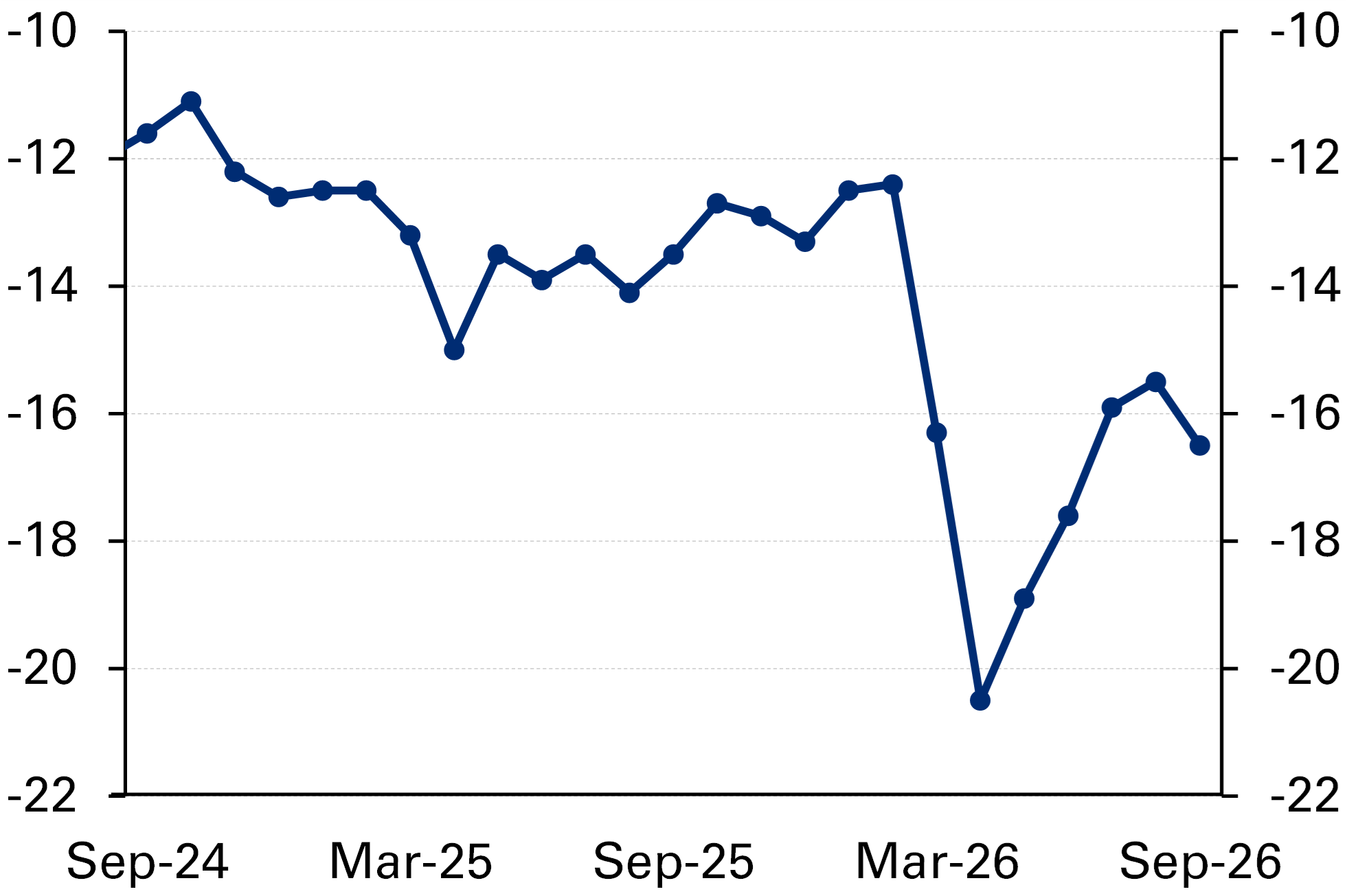
Eurozone: Consumer confidence weakened in September, ending a four-month run of improvement. According to the flash estimate released yesterday, the consumer confidence index fell to -16.5 in September from -15.5 in August, coming in slightly weaker than expectations of -16.0. The decline marks the first deterioration since April, reversing the gradual improvement seen over the previous four months, which had lifted sentiment to a six-month high. The latest reading suggests that households have become somewhat more cautious amid ongoing geopolitical uncertainty and renewed concerns over inflation.