
 +965 2292 4888


Daily Economic Update
08.11.2026
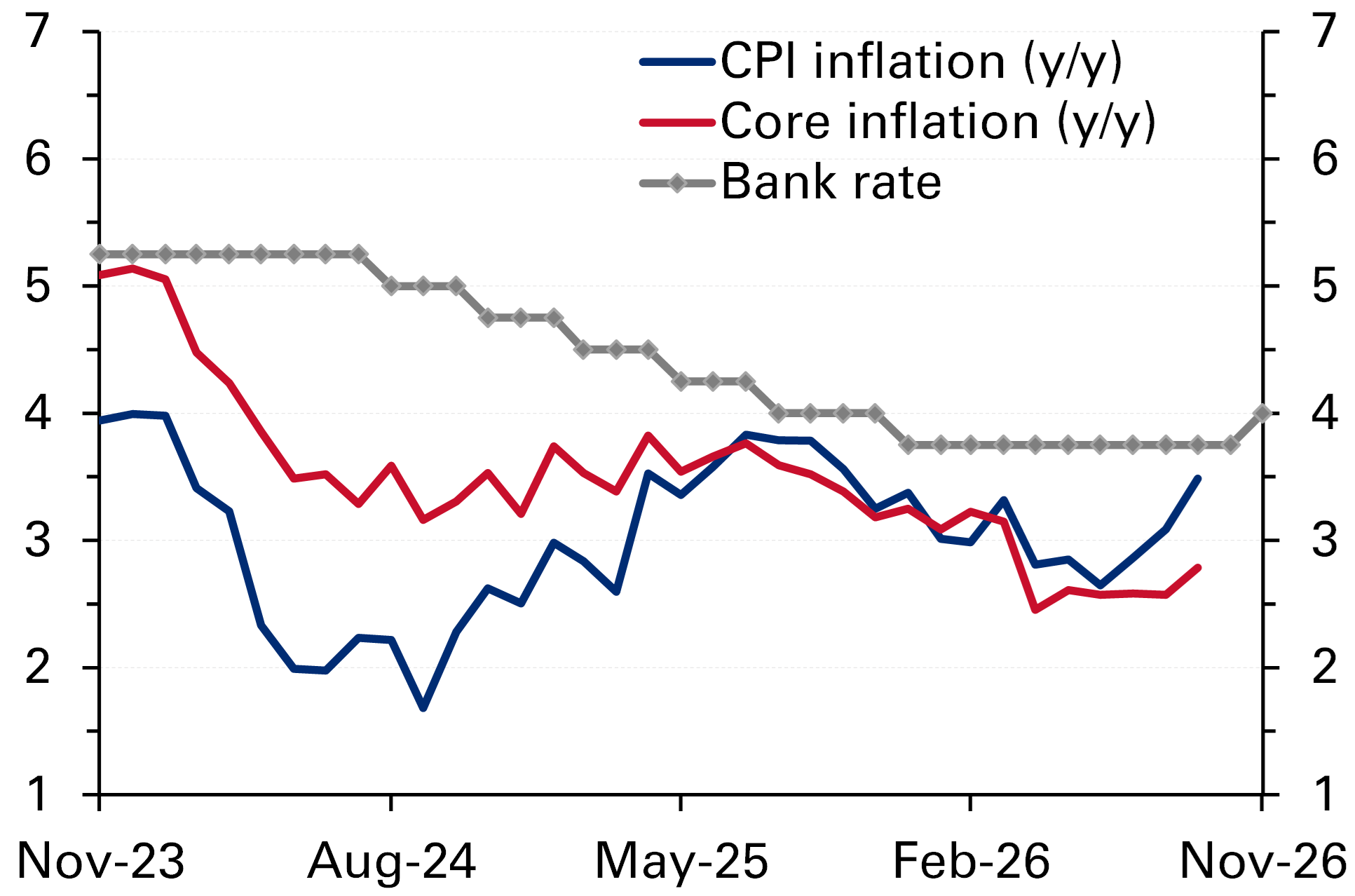
UK: BoE hikes interest rates by 25bps sounding hawkish as inflation expected to further climb in 2027. The Bank of England (BoE) raised the bank rate by 25bps in an 8-1 vote, with one MPC member (Catherine Mann) favoring a larger 50bps hike. The MPC noted that despite limited evidence of higher energy prices’ knock-on effects on other prices and wages, “the degree of inflationary pressure in the pipeline is now sufficient to warrant an increase in Bank Rate.” The bank sharply lifted its inflation projections, expecting CPI inflation to peak at 4.9% by Q2 27 (3.5% y/y in September), up from the anticipated peak of just above 4% previously seen by Q1, mainly due to rising energy prices and the expected regulatory increase in household energy bills next year. It also upgraded GDP growth forecasts to 1.6% for 2026 (from 1.1% seen in July) and to 1.3% for 2027 (from 1.1%) given resilient activity. BoE Governor Andrew Bailey stated that unless there was a progress towards resolving the Middle East conflict, “a further increase in bank rate may be warranted,” emphasizing that if risks to inflationary pressures don’t soften “I can see the argument for a further increase in rates and thereafter taking a more conditional approach.” However, he also mentioned that the latest rate increase “should not be seen as the first in an inevitable long sequence of hikes.” Given the MPC decision to increase the bank rate was unanimous and more hawkish than the market expectation of two members supporting a rate hold, the futures market boosted the chance of another hike in December to around 50%, projecting a total of two to three additional hikes by end-2027. We note that the UK economy has remained surprisingly resilient in recent months posting strong growth rates while the job market is showing some early signs of stabilization, which could drive the BoE to adopt a more hawkish stance if energy prices remain elevated.
Eurozone: ECB President says core inflation will be a key factor in determining ECB’s December rate decision. ECB President Lagarde reiterated that Eurozone inflation numbers will remain high in the coming quarters, emphasizing that “the higher they are, and the longer they remain high, the greater the risk to our medium-term target.” Inflation numbers released last week put the headline CPI rate at an over three-year high of 4% y/y in October but the core rate at just 2.5% (versus 2.4% in pre-war February). Importantly, second-round inflation effects and inflation expectations remain under control. As for the December ECB meeting, Lagarde mentioned that the bank will be looking at a detailed breakdown of core inflation to determine its interest rate decision. Separately, Eurozone retail sales for September were weaker than expected, falling 0.7% m/m, though growth in August was revised higher to 0.4% m/m from 0.1%. The drop in September was mainly driven by a 1.2% fall in non-food products. On an annual basis, growth decelerated to a muted 0.4%, in line with July’s growth, which is the weakest level in more than two years.
US: Several Fed officials wary of high inflation but New York Fed president doesn’t commit to a rate hike soon. With the labor market in good shape, several Fed officials remained concerned about higher inflation risks. John Williams, President of the New York Fed who holds a permanent vote on the FOMC, cited that inflation was "absolutely too high" but didn’t see many concerns with other indicators including wage growth and inflation expectations. He emphasized that this was “an appropriate time to accumulate more information” to determine the appropriate policy stance, without offering clues about his preference for the December meeting. We note that previous comments from Williams along with Fed Board Vice Chair Jefferson’s were instrumental in tempering the market expectations in favor of a hold ahead of the FOMC meeting in October. However, other regional Fed presidents, Beth Hammack (Cleveland, a voting member in 2026) and Thomas Barkin (Richmond) saw the need for gradual interest rate hikes to bring inflation down. Similarly, San Francisco Fed President Mary Daly (non-voting) and St. Louis Fed President Alberto Musalem (also non-voting) underlined the need to combat rising inflation, with Daly expressing her expectations about a further tightening in policy. The futures market currently signals an over 75% probability of a 25bps rate hike in December.
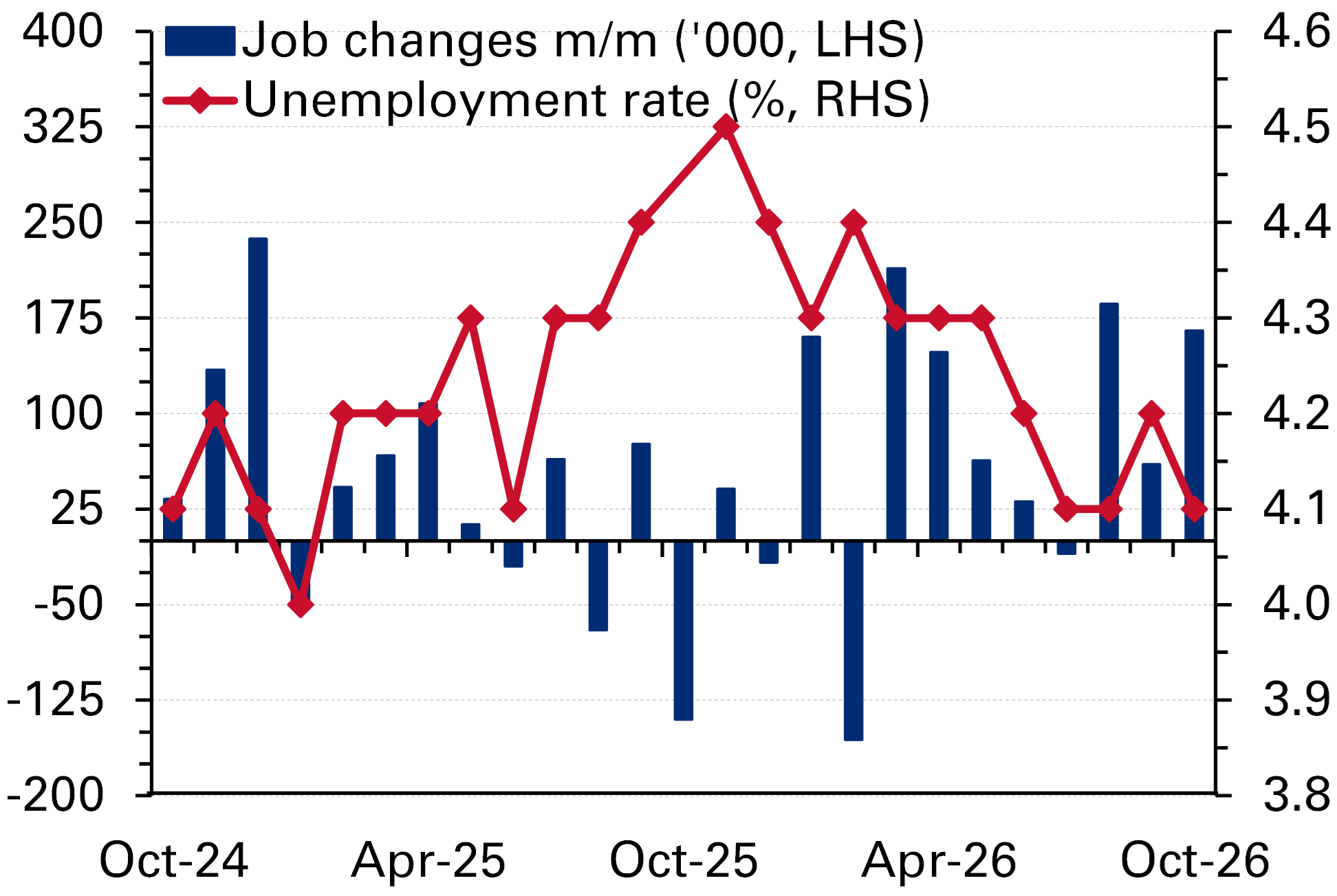
US: Solid job data signals further improvement in employment market conditions. Several labor market indicators released recently continued to signal a further improvement in labor market conditions. Non-farm payrolls increased by a more-than-expected 165K m/m in October after a rise of 60K in September. Moreover, job growth in August and September was revised higher by a combined 84K. The unemployment rate dropped to 4.1% in October from 4.2% in September, matching the lowest level seen since February 2025, with the participation rate improving to 61.9% from 61.8%, a seven-month high. Wage growth accelerated to 0.4% m/m from an upwardly revised 0.3% in September but ticked down on an annual basis to 3.1% from 3.2%. Indicating low firings, initial weekly jobless claims (w/e October 31) fell to match the lowest level in 57 years to 189K from 195K the previous week, with continuing claims (w/e October 24) staying near their over three-year low of 1.72 million. Separately, labor productivity growth strengthened to 3.6% (annualized) in Q3 from an upwardly revised 2.1% in Q2. Though quarterly data tend to be volatile, robust and higher labor productivity has been a key feature of the US economy versus its developed market peers. Overall, the latest job market data confirms that the worst is likely behind us as job growth, despite being volatile on a monthly basis, has been recovering after a very weak performance in 2025 (an average rise of 86K/month in YTD 2026 versus just 10K in 2025), with unemployment remaining low.
Japan: Ueda mentions upside risks to underlying inflation staying at 2%, cash earnings continue strong growth. In remarks delivered on Friday, BOJ Governor Kazuo Ueda stated that underlying inflation has approached the 2% target, and the economy is in equilibrium, cautiously warning that there are upside risks in terms of maintaining inflation at the 2% level. Markets are pricing in a further rate hike in December as the BOJ governor has maintained a cautious tone about inflation and the economy, with continuous signaling that a December hike is likely if underlying inflation exceeds the 2% target. Separately, employees cash earnings rose 4.6% y/y in September, beating expectations and marking an eighth consecutive month of growth above 3%. The figures provide some reassurance that sustained wage increases will keep the BOJ on track to raise its benchmark rate further.
Kuwait: FDI rose sharply in fiscal year 2025/26. According to the 11th Annual Report of the Direct Investment Promotion Authority (KDIPA), foreign direct investment (FDI) inflows surged to KD 948 million (approximately $3.1 billion) in FY2025/26, nearly four times the level recorded in the previous fiscal year. However, around 64% of these inflows came from one investor, a Chinese construction company, indicating that the headline growth was heavily concentrated. During the year, KDIPA approved 17 new investment entities, while the cumulative value of approved investments since 2015 reached KD 2.9 billion (around USD 9.6 billion), with FY2025/26 accounting for 32.5% of the total. Over the 2015-2026 period, approved investments were led by the construction and infrastructure (31%), information and communications (23%), and oil and gas (19%) sectors, with the majority of investment coming from Chinese firms. While the figures reflect Kuwait’s success in attracting large-scale investments and advancing the objectives of Kuwait Vision 2035, the high dependence on a small number of large projects and investors suggests some ongoing concentration risk. Sustaining FDI growth over the long term will require a broader and more diversified pipeline of investments across sectors and source countries to ensure resilient and stable inflows.
Download Full Report >