
 +965 2292 4888


Daily Economic Update
21.01.2026
US: Markets see steep sell-off but Supreme Court ruling could yet limit the US administration’s tariff plans. President Trump took the use of tariffs to an unprecedented level, vowing to hit even US’s traditional and long-standing allies with import duties for geopolitical gains. The latest escalation, 10% tariffs (rising to 25% in June) on eight European countries for opposing his Greenland takeover plan, and threatening to hit French wines and champagne with 200% tariffs seemingly because President Macron refused to join the newly conceived Gaza Board of Peace, go beyond typical usage of tariffs, which are usually levied for trade and economy-related matters. In this context, the US Supreme Court’s pending verdict on the legality of the country-specific tariffs implemented through an emergency power act is key. Yesterday, the Court again did not rule on the tariffs with the next potential window the second half of February. The Court may render these tariffs illegal and limit the president’s ability to abruptly and single-handedly impose such levies, which in Greenland’s case could upend the global geopolitical and economic order. In that scenario, the US administration would likely push to recreate the tariff wall using other legal means, but those mechanisms are more complex and time consuming to enact. In all cases, President Trump seems very keen in his pursuit of Greenland such that even if he is forced to retract his tariff threats, he may try other means to achieve the goal. Market reaction is one factor that could yet restrain such moves, just like in April last year, and the market reaction was violent yesterday (though that was also related to developments in Japan). US equity and bond markets were deep in the red yesterday with the S&P 500 down 2.1%, while UST 10Y bond yields rose by 7 bps to around 4.29%, the highest close since late August. European markets sold off sharply as well. Gold and silver posted new record highs, with gold shooting above the $4,700/ounce mark. In Japan, yields on the 10Y and 30Y government bonds also climbed to their decades-high of 2.34% and 3.85% respectively, on concerns about worsening fiscal situations after PM Takaichi called for snap parliamentary elections.
UK: Weak labor data further weighs on an already uninspiring economic outlook. Continuing the trend seen since late 2024, the UK economy shed employment again in December. Payrolls (based on employment tax records) fell further in December by 43K after declining by a revised 33K in November, taking the total drop to around 220K since the announcement of higher national insurance contributions in 2024’s Autumn budget. The unemployment rate was unchanged at 5.1% in the September-November period, the highest since November 2020-January 2021, but encouragingly, the participation rate ticked up to 64% from 63.9%, its best since the start of the pandemic in 2020. Pay growth data was mixed, with regular wage growth easing to the lowest level since February-April 2022, standing at 4.5% y/y in September-November (in line with expectations) from 4.6% in August-October, but total pay growth softened less than expected to 4.7% from an upwardly revised 4.8% in the prior period. Job vacancies slightly ticked up to 734K in October-December but remained near an almost five-year low. A weak labor market landscape continues to weigh on the UK economic outlook; the IMF, in its January WEO update, left its UK GDP growth forecast unchanged at 1.3% in 2026 and 1.5% in 2027 (1.4% in 2025). However, a sustained deceleration in wage growth should encourage the Bank of England to cut policy interest rates further this year.
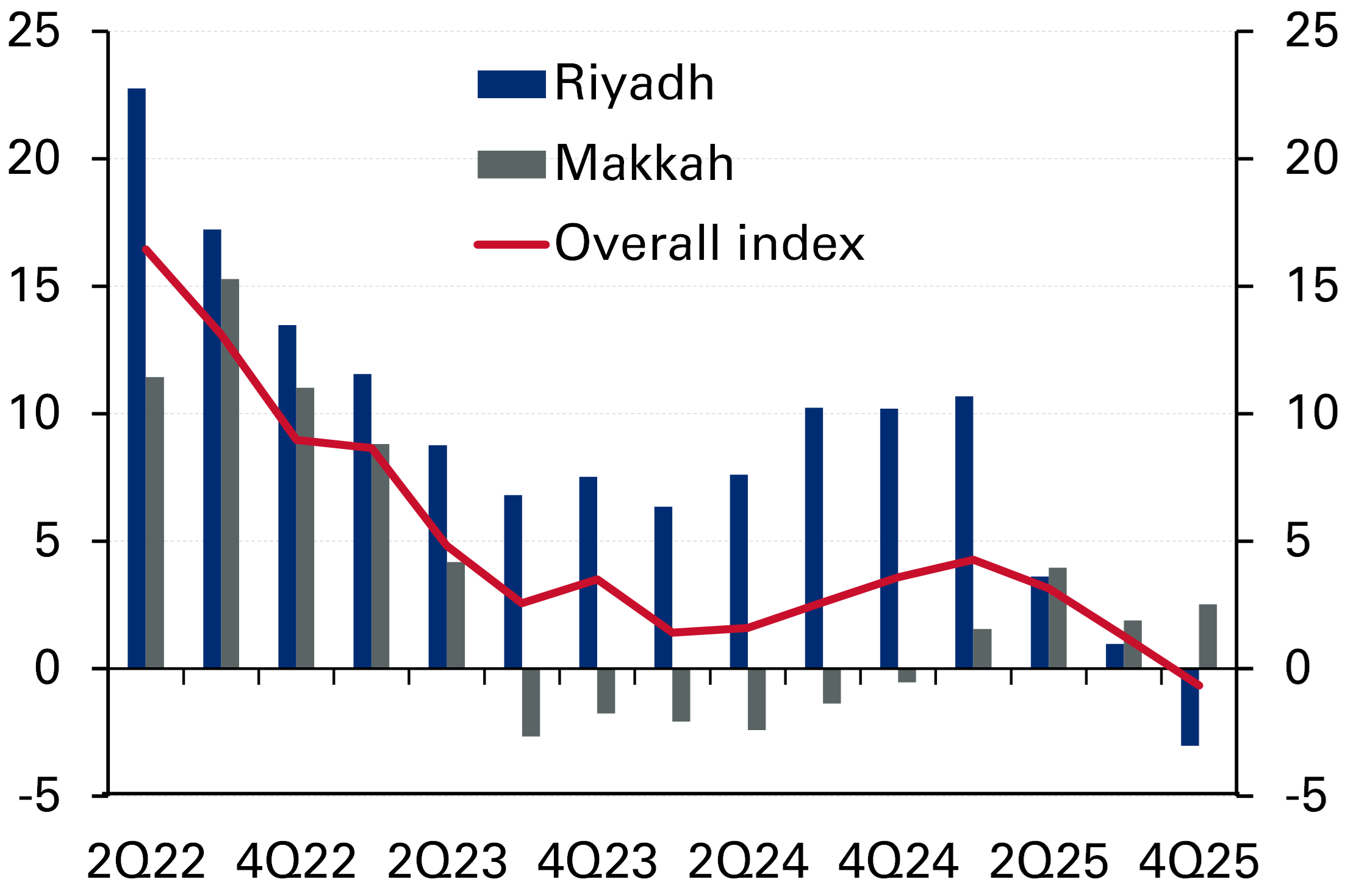
Saudi Arabia: Residential prices continued to decline in Q4. The official real estate price index registered a decline of -0.7% in Q4 2025 (from 1.3% in Q3), the first decline in the four-year series, weighed down by a 2.2% y/y drop in residential sector prices. Price changes were mixed across the various regions, reflecting different market dynamics, with relatively steep declines logged in Riyadh (3%), Madinah (6.1%), and Hail (9%). The Q4 reading marks the second consecutive quarter of declining residential prices (on an annual basis), likely affected by government efforts during 2025 to boost supply while curbing speculative demand and rent-seeking activities. The measures included a revised, more restrictive white-lands tax, a new tax on vacant properties, and a 5-year rental freeze in Riyadh. On a quarterly basis (q/q), residential prices fell for the third consecutive quarter, though at a notably softer pace in Q4 (-0.4% vs -1.1% and -2.6% in Q3 and Q2) which we interpret as a sign that the negative price trend may be stabilizing, in part due to anticipation of new foreign demand from the law allowing foreign participation which came into effect earlier this month. Moreover, fundamentals remain tight especially in the Riyadh residential market, with continued strong housing demand and a lagging supply of new residential units. Given these factors, and with the sustained growth of the non-oil economy, we see scope for more stable prices in the Riyadh residential sector over the coming quarters.
Oman: Inflation cools slightly at year end. CPI inflation eased slightly to 1.6% y/y in December 2025, down from 1.7% in November, with prices declining by 0.1% m/m. This brought average inflation for 2025 (January to December) to 1% y/y. The moderation in December was mainly driven by slower price increases in transport (2.8% y/y versus 4.4% in November) and restaurants & hotels (2.6% versus 2.7%). In contrast, inflationary pressures picked up in food & non-alcoholic beverages (1.1% versus 0.9%) and in miscellaneous goods & services (10.1% versus 9%). Meanwhile, inflation was unchanged across several categories, including housing & utilities (0%), tobacco (0%), furnishings (2.4%), clothing and& footwear (0.2%), communication (0%), education (2.2%), health (0.1%), and recreation & culture (-0.1%).