
 +965 2292 4888


Daily Economic Update
14.10.2026
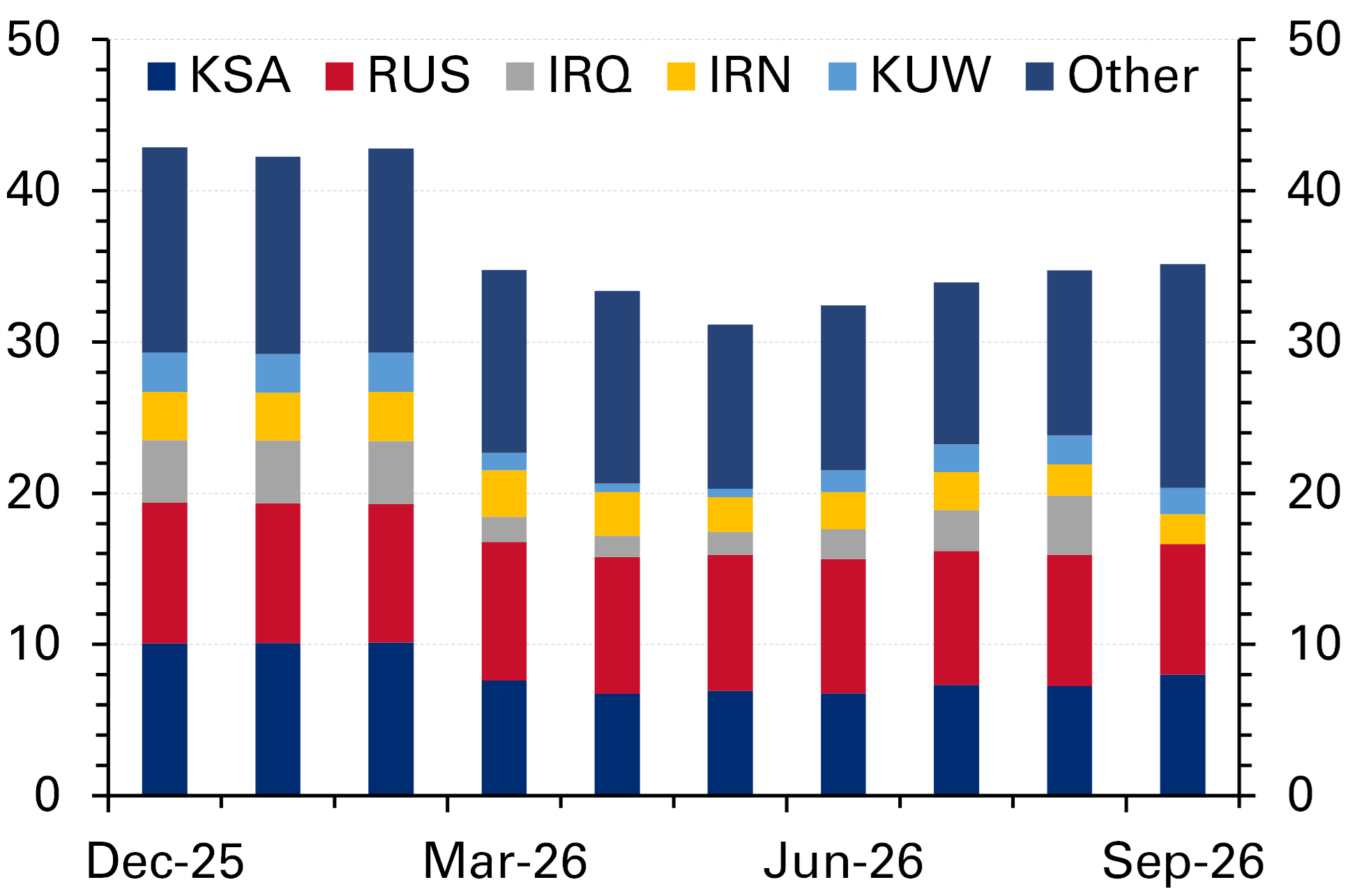
Oil: OPEC lowers its oil demand growth forecast for 2026 as Saudi production surges in September. In its latest oil market report, OPEC downgraded its estimate for demand growth this year to 0.2 mb/d from 0.4 mb/d previously, due largely but not exclusively to the impact of the conflict in the Gulf. The group expects oil consumption growth to accelerate to 2.6 mb/d (to 108.3 mb/d) in 2027, with support coming from expected global stock rebuilding. In terms of September supply levels, the OPEC Secretariat reported DoC production increasing by 1.2% m/m to 35.2 mb/d, the highest since the outbreak of the conflict, according to secondary sources. Aggregate output was helped by a rebound in Saudi crude production to 8 mb/d (+10.3% m/m)—also the highest since February. However, the official Saudi submission to OPEC reported that crude production jumped by nearly 2 mb/d to 8.37 mb/d, a massive resumption in wellhead flows after August’s near three-decade low, signaling both that the authorities were able to successfully re-route supplies back towards the Strait of Hormuz after the East-West pipeline was taken offline and that Saudi Aramco was looking to replenish storage levels (since crude supplied to market was reported lower at 7.98 mb/d). Venezuela and Algeria were the only other OPEC members to post output gains in September. For Venezuela, its September production reading of 1.15 mb/d is the highest in almost seven years, a sign that US stewardship of the Venezuelan oil sector post-Maduro was indeed bringing dividends as far as oil production was concerned. In contrast, among the five OPEC members reporting production declines in September, Kuwait’s was the steepest (-140 kb/d to 1.77 mb/d), as KPC likely pulled back export flows amid the spike in transit risks through the Strait. Meanwhile, the UAE, which left OPEC in May, continued to ramp up output, setting a record of 3.92 mb/d in September. Oil prices were up this morning in Asian markets at the time of writing (+0.6% d/d to $106.3/bbl), reacting to attacks on two vessels in the Gulf on Tuesday—likely from Iran as part of its openly disclosed new offensive strategy to target ships that undermine its control of the Strait—and a Houthi strike on Aramco’s headquarters. Also, it was announced yesterday by Saudi energy minister Prince Abdulaziz bin Salman that Aramco would increase the capacity of its vital East-West pipeline carrying crude to the Red Sea port of Yanbu by 3 mb/d (+43%) to 10 mb/d. About 5.8 mb/d of oil is believed to be flowing through now after the pipeline was brought back into service following the Houthi attack in September, and the additional capacity once completed would likely cover the entirety of the kingdom’s oil exports.
Saudi Arabia: IMF expects strong recovery in 2027 after contraction. The International Monetary Fund projects Saudi Arabia’s economy to contract by 3.3% in 2026 before rebounding by 7.9% in 2027, as energy production and exports recover from the impact of the Iran conflict and disruptions to shipping through the Strait of Hormuz. In its October World Economic Outlook, the IMF noted that Saudi Arabia was relatively less affected than other regional economies, thanks to its alternative oil export routes. The latest forecasts represent a sharp revision from the IMF’s April projections, which anticipated growth of 3.1% in 2026 and 4.5% in 2027, to reflect continued disruption this year followed by an expected strong recovery. Saudi Arabia’s resilience is partly supported by its soon-to-be-expanded East-West pipeline, which bypasses the Strait of Hormuz chokepoint. However, the IMF’s recovery outlook is contingent on the Strait reopening by March 2027 and a broad return to pre-conflict conditions by October. The Fund assumes a gradual recovery in production, shipping, insurance, and payment arrangements, with stockpiles and alternative export routes helping to ease supply shortages in the meantime. It also projects an average oil spot price of around $96 per barrel in 2026, 16% above its April forecast.
UAE: New three-year budget cycle approved for 2027-2029. The UAE cabinet has approved a new, three-year federal budget framework for 2027-29 totaling AED293 billion ($80bn). According to Sheikh Mohammed bin Rashid, Vice President and Ruler of Dubai, this represents a 28% rise on the previous 3 years. The first-year allocation of AED90.1 billion for 2027 is only marginally below the record AED92.4 billion budget approved for 2026 (-2.5%), signaling the authorities' intention to maintain elevated spending levels in the aftermath of the US-Iran conflict (2028-29) and support infrastructure maintenance, digital transformation, and investment across priority sectors to reinforce the UAE's long-term development agenda. The largest allocations were directed towards social development and pensions (38%), followed by government affairs (32%) and federal expenses (19.7%). It is worth noting that the federal budget represents only a portion of public sector spending in the UAE, indicating that the consolidated fiscal performance will continue to be driven primarily by the budgets and investment activity of the individual emirates, particularly Abu Dhabi and Dubai.
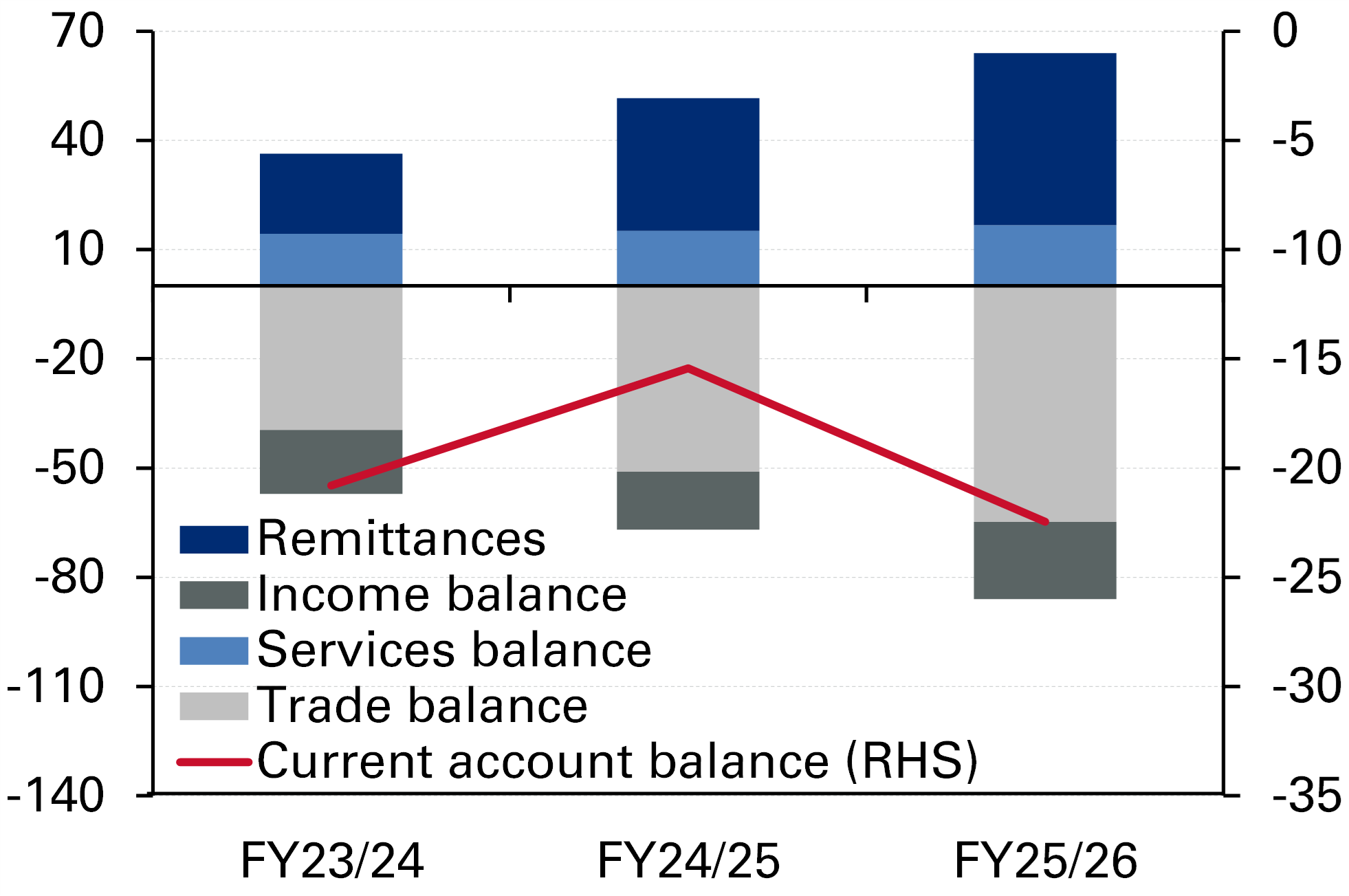
Egypt: Current account deficit widens, but overall balance of payments returns to surplus. Egypt’s current account deficit widened by 46% y/y to $22.5 billion in FY25/26, up from $15.4 billion a year earlier, reflecting a larger merchandise trade deficit and higher investment income outflows. The merchandise trade deficit increased by 27% to $64.8 billion, as the oil trade deficit widened (+32% to $18.3bn) amid higher oil imports, while the non-oil trade deficit rose (+25% to $46.6bn), driven partly by higher non-oil imports (+16.9% to $83.9bn). The investment income deficit also widened (+34% to $21.2bn). However, stronger remittances and services receipts partly offset these pressures. Remittances from Egyptians working abroad rose by 30% to a record $47.3 billion, while the services surplus increased by 10.5% to $16.7 billion, supported by tourism revenues ($18.4bn) and Suez Canal receipts ($4.4bn). Despite the wider current account deficit, Egypt’s overall balance of payments recorded a surplus of $2.8 billion in FY25/26, reversing the deficit ($-2.1bn) from the previous year. This improvement was supported by a more-than-doubling of net capital and financial account inflows ($23.2bn). Foreign direct investment generated net inflows of $17.8 billion, while portfolio investments recorded net inflows of $4.1 billion. The overall surplus signals improved external financing conditions, although the widening current account deficit highlights Egypt’s continued dependence on remittances, tourism, investment inflows and other sources of foreign currency to meet its external financing needs.
US: Fed’s Williams sees one more rate hike this year but none in 2027; Governor Waller cites threat to Fed independence. John Williams, the New York Fed President (a permanent voting member and the FOMC Vice Chair) repeated his previous view that “it may be appropriate to have one more rate hike” but importantly added that “I don’t think at this time I have any reason to believe that we would need to do more”. He mentioned that despite the energy price and tariff shocks as well as AI-driven demand, some measures of underlying inflation have come down, with disinflationary forces remaining in play, though he emphasized that he remains watchful of incoming data. We note that Williams’ views in late September had helped push market expectations of a rate hike in the FOMC’s October meeting sharply down. The futures market currently signals a near 80% probability of no change in the Fed rates in October but a hike in December is firmly priced in. Separately, Fed Governor Christopher Waller highlighted that rising bond yields were “doing a little bit of the [Fed’s] work”, echoing earlier comments from Chair Warsh. Importantly, he mentioned that “there is a threat to Fed independence by the administration”, but “so far, it hasn’t really succeeded”, citing his faith in Congress and the courts. President Trump continues to attempt to influence the Fed’s monetary policy decisions, calling the Fed’s Board “very hostile, very political” following the September hike, and is still aiming to fire Governor Lisa Cook from her post after unsuccessfully pressuring former Fed Chair Powell to step down.
China: Exports soar by 36% y/y in September as inflation remains contained. China's external sector delivered another strong performance in September, with exports soaring 36% y/y, accelerating sharply from August's 25% increase, which comfortably exceeded market expectations. The sharp acceleration in exports suggests Chinese manufacturers continue to benefit from strong global demand, particularly from technology and advanced manufacturing industries. Exports to the US continued to strengthen, surging 40% y/y as trade tensions between the two countries continued to ease following an agreement to roll back tariffs on $30 billion of goods and extend their trade truce into January. Exports to the EU also rallied by 25% y/y. Meanwhile, import growth indicates that domestic firms remain active in replenishing inventories and sourcing industrial inputs, helped by resilient demand for technology-related equipment and elevated commodity prices as well as inventory accumulation ahead of the Golden Week holiday. However, the volume of China’s crude oil imports continued to fall by double-digits. The latest trade figures reinforce the view that external demand remains a key source of support for China's economy. Separately, China's inflation rate rose to 0.9% y/y in September from 0.8% in August, marking the highest reading since June, although it came slightly below market expectations of 1.0%. The increase was driven by firmer non-food inflation, which accelerated to 1.5% y/y in September from 1.2% in August, supported by a sharper rise in transportation costs (+4.3% from +2.5%) amid higher gasoline prices and stronger travel demand ahead of the Golden Week holiday. Additional upward pressure came from healthcare, education and clothing prices. Meanwhile, core inflation, which excludes food and energy, held steady at 1.0% y/y, indicating that underlying domestic demand pressures remain contained. At the production level, price pressures intensified, with PPI inflation accelerating to 5.0% y/y in September from 3.8% previously, its strongest pace since mid-2022, driven largely by rising energy and raw material costs that pushed up prices across the mining, processing and industrial input sectors.