
 +965 2292 4888


Daily Economic Update
12.10.2026
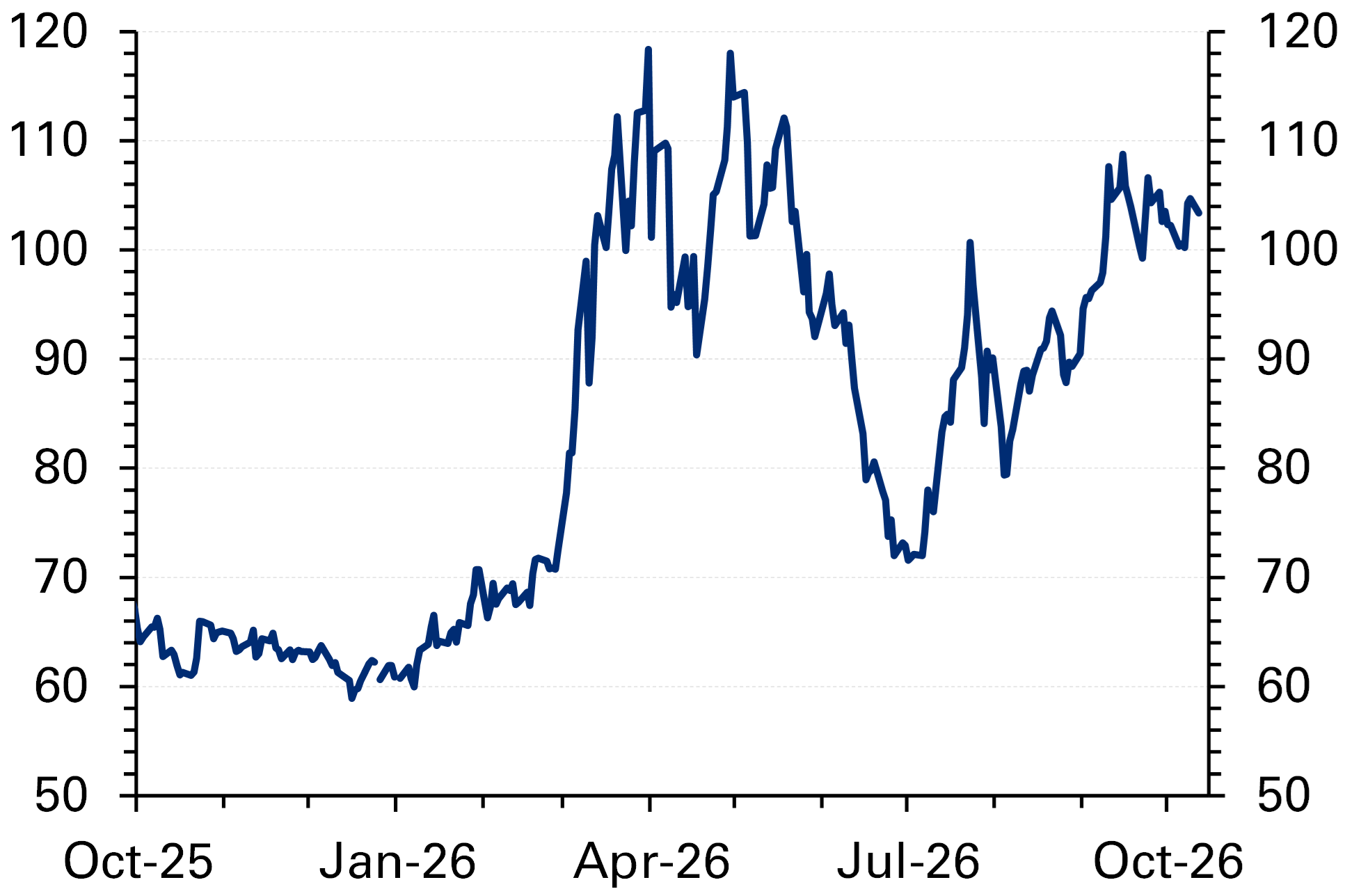
Oil: Prices rise amid renewed hostilities in the Middle East. Brent futures rose last week, settling at $104.7/bbl on Friday (+2.4% w/w), as escalating geopolitical tensions in the Middle East offset bearish developments elsewhere and as Hurricane Isaias temporarily disrupted production in the US Gulf Coast region. Support came from reports that Washington was considering military action against Iran, although US President Trump later downplayed those reports, stating that discussions with Tehran remained "productive". At the same time, Hurricane Isaias churned towards the northern Gulf of Mexico, prompting oil companies to shut down more than 70% of their offshore crude production. Meanwhile, Houthi attacks on Saudi infrastructure continued, raising concerns over the security of the Kingdom's energy assets and reigniting regional geopolitical risk anxieties. Recent strikes on Saudi Arabia, including multiple attacks on Riyadh airport in the last few days that caused many fatalities, show the Houthis upping the ante and intensifying the severity of their attacks, in tandem with Iran’s increased targeting of vessels transiting the Strait of Hormuz. Price gains occurred despite efforts to ease supply tightness through the acceleration of strategic stock releases and higher oil flows through the Strait of Hormuz. The IEA has accelerated the release of emergency reserves, including around 50 mb of diesel, as part of the broader program announced in March. To date, roughly 325 mb has been released at an average rate of 1.5 mb/d, though structural constraints appear to be limiting the pace at which additional volumes can reach the market. In that vein, the Trump administration announced over the weekend a lifting of a US ban on Russian diesel exports, initially thought to total around 13.5 mb, designed to help ease the increasingly tight diesel market, though it is doubtful whether the volumes supplied will be anywhere near enough to make a material impact on supply and ultimately US retail prices, the ultimate Trump objective ahead of the US midterms next month. This and the Trump administration’s claim that Russia and Ukraine had agreed to an ‘energy ceasefire’ has helped take some of the steam out of Brent’s run this morning in Asian markets. Brent opened lower and was last seen trading at around $103.4/bbl. Attention now turns to this week's release of OPEC's and the IEA's monthly oil market reports, due on Tuesday and Wednesday, respectively. Market participants will be watching closely for any revisions to supply and demand forecasts, particularly given ongoing disruptions to Middle Eastern exports, elevated geopolitical risks, and continued pressure on global oil inventories.
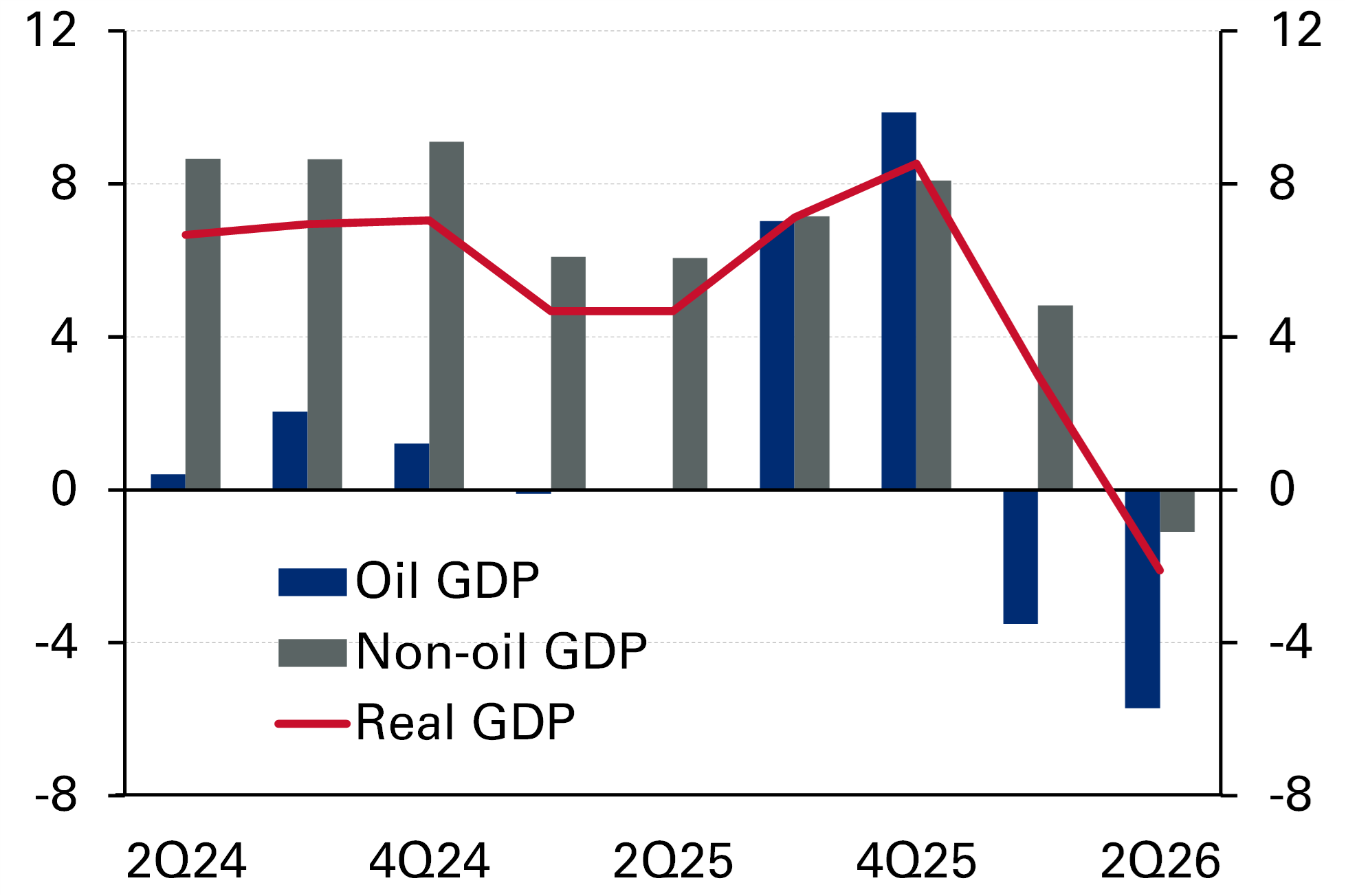
UAE: Economic growth weakens in Q2 amid conflict-linked disruptions to both the oil and non-oil sectors. The UAE economy weakened in the first half of the year, the Emirates’ Federal Competitiveness and Statistics Center reported, with real GDP eking out growth of 0.4% in 1H 2026 but contracting in the April-June period by 2.1% y/y. The economy’s performance in Q2—sharply reversing the 3.0% expansion in Q1 to contract for the first time in more than five years—was driven primarily by the oil sector, which saw output extend its decline (-5.7% y/y from -3.5% in Q1) on the back of a more-than-10% y/y drop in crude oil production (2.65 mb/d), according to OPEC data (direct communication). The weakness was largely a reflection of the disruption to oil exports and production caused by the US-Iran conflict, namely the closure of the Strait of Hormuz and the attacks on key UAE energy assets including the Habshan gas-processing and Ruwais industrial and refinery complexes. However, the oil sector showed notable resilience, with ADNOC mitigating bottlenecks by stepping up exports through ship-to-ship transfer operations and flows through the 1.5-1.8 mb/d Abu Dhabi Crude Oil Pipeline. Meanwhile, non-oil GDP contracted 1.1% y/y in Q2 (+4.8% in Q1). This was due to sharp declines in the manufacturing (-12.1% y/y), transportation (-12.2%), accommodation & food services (-18.7%) and wholesale and retail trade (-4.0%) sectors, largely reflecting the disruptions to regional airspace and maritime traffic caused by the conflict. There was a noticeable reduction in passenger traffic and tourist numbers, as would be expected, while the disruption to shipping and maritime traffic through the SoH increased logistical costs and affected transportation and trade-related services. However, several economic sectors including financial & insurance activities (+12.3% y/y) and construction (2.2%) exhibiting resilience by posting continued growth. The data for Q3 when it comes out should show a moderation in the economic impact of the conflict, in line with the lessening in attack intensity on key regional energy and transport infrastructure relative to the peak in March and April. As security conditions stabilize, the visible recovery in tourism, transportation, logistics, and business sentiment could support a modest rebound in non-oil activity. However, the outlook for Q4 and beyond remains highly dependent on the trajectory of the conflict.
Egypt: Banque du Caire plans 30% IPO, reviving privatization efforts. Banque du Caire (BdC) has taken a step towards listing on the Egyptian Exchange (EGX), with plans to offer 30% of its shares to investors. Banque Misr, the bank’s state-owned parent, will sell around 4.6 billion existing shares and receive the proceeds, meaning BdC itself will not raise new capital through the offering. The IPO values the bank at around EGP 80 billion, putting the 30% stake at approximately EGP 24 billion ($460 million). This implies a valuation of around 1.2 times book value and five times its 2025 earnings, broadly in line with sector multiples. The offering is expected to conclude in late October, with trading potentially beginning in November, subject to regulatory and EGX approvals. The offering has reportedly attracted interest from foreign institutional investors, supported by a European roadshow held last month that helped secure international participation in the private placement. The listing would mark a significant step in reviving Egypt’s privatization program and expanding the role of private investors in the state-owned banking sector.
China/EU: Preliminary agreement on trade helps ease tensions, but broader challenges remain. The European Union and China reached a preliminary agreement on Friday aimed at easing trade tensions, which have been on the rise, focused primarily on Chinese exports of hybrid and plug-in hybrid vehicles to the bloc. Following months of negotiations that culminated in two days of talks in Beijing, China agreed to restrain hybrid vehicle shipments as part of a broader 16-point framework covering trade, investment, and export controls. The preliminary agreement comes ahead of discussions among EU leaders on whether to pursue stronger trade defense measures against China over concerns about subsidized exports and a trade imbalance exceeding €1 billion per day ($1.1 billion); Chinese exports to the EU have grown by a solid 15% in 8M2026. In the near term, the agreement is expected to reduce pressure on EU industries and may help avert a more forceful trade response from Brussels. However, the deal does little to address the underlying causes of the EU's large trade deficit with China, suggesting that while tensions may ease temporarily, broader trade frictions are likely to persist.
Global: Fed Chair Warsh’s appearance during the IMF annual meetings and US CPI inflation key matters this week. In the US, Fed Chair Warsh will take part in a discussion with IMF MD Georgieva on Friday as part of the IMF’s autumn annual meetings. Attention will be on whether he provides any hints about forthcoming monetary policy, noting that the Fed, the following day (Saturday), enters its official blackout period ahead of its upcoming meeting on 27-28 October. Several other Fed officials will also speak this week, noting that recent “Fed speak”, especially by influential FOMC members, has filled the void left by the Chair and has had a significant impact on the market’s expectation about the Fed’s rate decision in October. In terms of data, CPI inflation for September (Wednesday) is seen accelerating to 3.6% y/y from August’s 3.4% and the core rate to 2.5% from 2.4%. Retail sales for September (Thursday) are seen increasing by 0.3% m/m following August’s steep 1.2% rise. In the Eurozone, industrial production in August (Thursday) is seen inching up 0.1% after a 0.1% decline in July. In the UK, GDP in August (Thursday) is expected to drop by 0.1% m/m after a solid 0.4% increase in July. In China, attention will be on September’s inflation and trade figures, due on Wednesday. CPI inflation is expected to edge higher to 1.1% y/y (0.8% in August) while PPI inflation is projected to accelerate further to 4.4% y/y (3.8% in August). Meanwhile, growth in exports and imports is seen remaining strong, standing at around 25% y/y and 23%, respectively, compared with 25% and 28% in August. Finally in Japan, September’s PPI inflation (Tuesday) is forecast to remain high, but unchanged from the 7.6% y/y recorded in August.