
 +965 2292 4888


Daily Economic Update
19.01.2026
US/Europe: President Trump stirs the tariff wound; Europe’s response, the market reaction, and the imminent Supreme Court decision are key. US president Trump threatened to impose 10% tariffs on eight European countries from February 1 to exert pressure to gather support for his Greenland takeover plans. The eight countries are Denmark, Norway, Sweden, France, Germany, the UK, the Netherlands and Finland. Trump also vowed to raise these tariffs to 25% by June until “a Deal is reached for the Complete and Total purchase of Greenland.” With this move, Trump has stretched the aim of using tariffs to an unprecedented level. It is difficult to see how the legality of such tariffs can be upheld by any court of law. In response, the EU was mulling to ready a trade retaliation package to hit the US goods with €93 billion (around $108 billion) in import duties, while French president Macron, labeling tariff threats as “unacceptable,” urged the EU to invoke an Anti-Coercion Instrument, which has never been used before, to restrict US tech companies’ access to European markets. Moreover, many EU lawmakers vowed to oppose the approval of the US-EU trade deal in the European parliament that was signed last year. UK PM Starmer also voiced opposition, saying, “applying tariffs on allies for pursuing the collective security of Nato allies is wrong.” Trump and several European leaders are travelling to Davos this week to attend the World Economic Forum, and some discussions on these developments may take place there. The key question is how Europe will respond to the encroachment of the sovereignty of a member state that is also a NATO member: a weak response like how it dealt with the tariff developments last year and ended up agreeing to an unfair trade agreement or more forceful (like China’s last year), which arguably proved to be more successful? In addition to Europe’s reaction, two factors can reverse this unprecedented move to use tariffs to seize Greenland: 1) a ruling by the US Supreme Court that Trump’s country-specific tariffs are illegal – the court’s ruling is imminent; 2) like what happened in April, a violent stock and bond market reaction. In all cases, the latest escalation and threats of a renewed trade war would compromise the long-standing alliances between the US and the EU and put the overall global geopolitical and economic orders at serious risk that may have far-reaching ramifications for the entire world. Finally, Trump expressed his aversion to nominate Kevin Hassett, who is currently the director of the White House National Economic Council, as the new Fed Chair, saying, losing Hassett from his current job would be “a serious concern” to him. Hassett, along with a few others, was previously touted as a frontrunner for the Fed chair post.
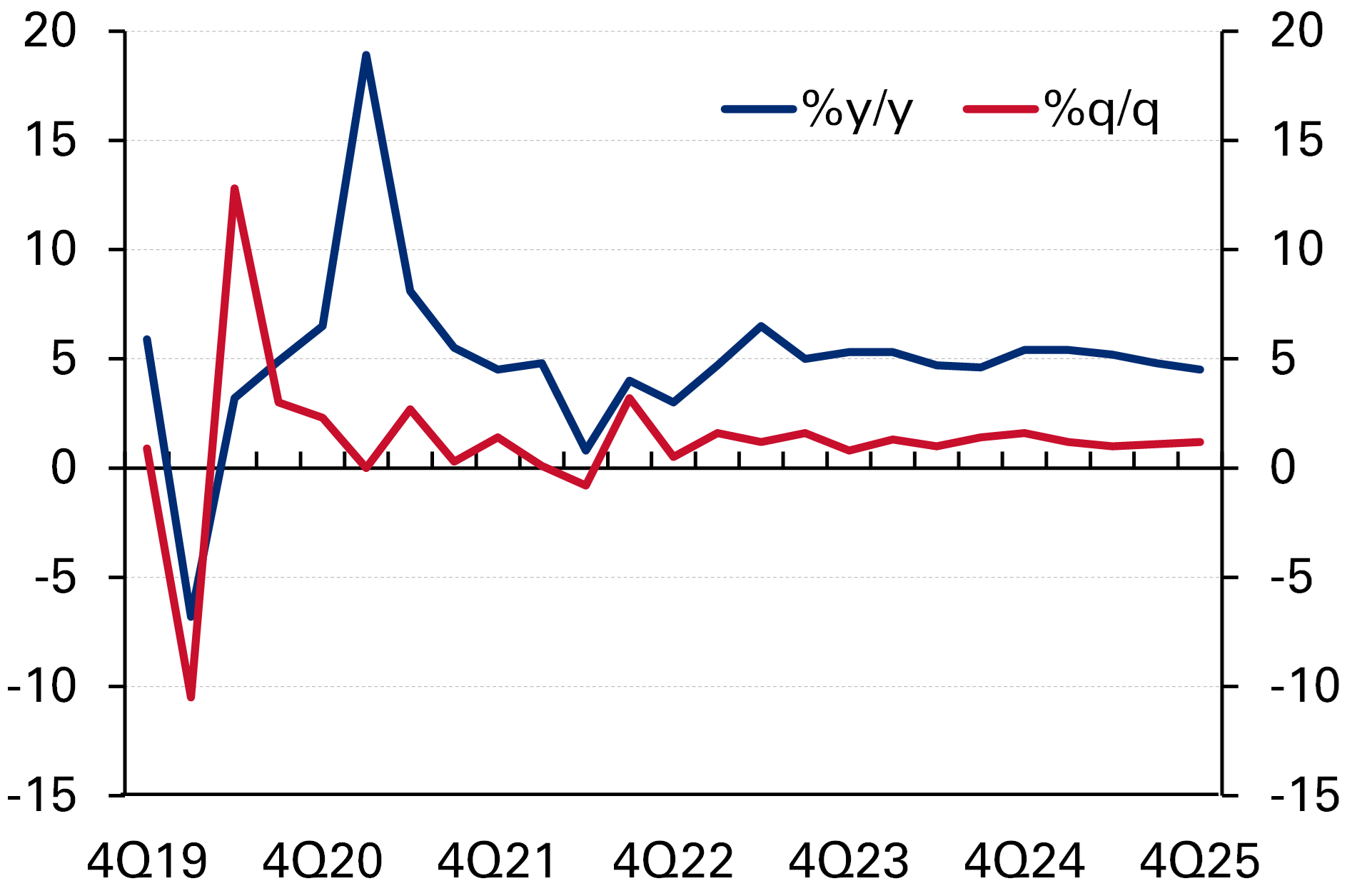
China: Fourth quarter GDP growth slows to 4.5%, though full year growth hits the 5% target. China’s economy grew 4.5% y/y in Q4 2025, slowing from 4.8% in Q3, marking the weakest rise in three years, as consumption and investment dragged. However, full-year economic output came in at 5%, meeting the official target of around 5%. Full year growth was driven largely by exports and manufacturing, suggesting that China’s dependence on external demand exposes structural weaknesses, as weak household spending, a drawn out property slump, and persistent price pressures continue to weigh on the domestic economy. Separate December data showed retail sales posting their weakest growth since December 2022 (+0.9% y/y). Industrial production rose 5.2% y/y in December, beating the 5% consensus and quickening from November’s 4.8%, while full-year fixed asset investment – including real estate – declined 3.8%, worse than market forecasts of a 3% fall. New house prices fell by 2.7% y/y in December, steeper than a 2.4% drop in November, marking 30 consecutive months of decline and the steepest drop since July, highlighting Beijing’s ongoing difficulty in stabilizing the protracted property downturn.
Oil: Prices rise third week running on Iran-linked geopolitical risk. Oil notched up a third consecutive weekly gain on Friday, rising 1.2% w/w to $64.1/bbl on Iran-linked geopolitical risk. However, the potential disruption to oil supplies that markets had been fearing last week amid a heavy-handed crackdown by the authorities on protesters did not materialize and President Trump’s threat of US intervention on behalf of the demonstrators appeared at least to force a shift in the Iranian authorities’ attitude to using violence to quell the dissent. This morning in Asian trading prices were fairly steady, despite more bellicose talk on Greenland by President Trump and his recourse to tariffs on the Europeans for opposing his plans to annex the territory. In data releases this week, Wednesday will see the International Energy Agency publish its first monthly oil market report of the year, which should provide some insight into what the agency expects for world oil demand growth this year and whether it sees any scope for adjustments to its forecast of an oversupplied market in 2026.
UK: Economy rebounds more than expected in November. UK GDP increased in November by 0.3% m/m (1.4% y/y) after a fall of 0.1% (+1.1% y/y) in October, led by services (+0.3% m/m following -0.3% in October) and a sharp jump in auto manufacturing output (+25%) as the auto sector further recovered from a cyber incident in August that severely impacted production previously. However, the construction sector sustained another fall, down by 1.3% m/m in November after posting a revised drop of 1.2% in October. A bigger recovery in the economy in November dispelled worries that business activity was being suppressed by pre-budget anxiety. Still, with a weak employment situation and frail consumer spending, the outlook for 2026 remains cautious.
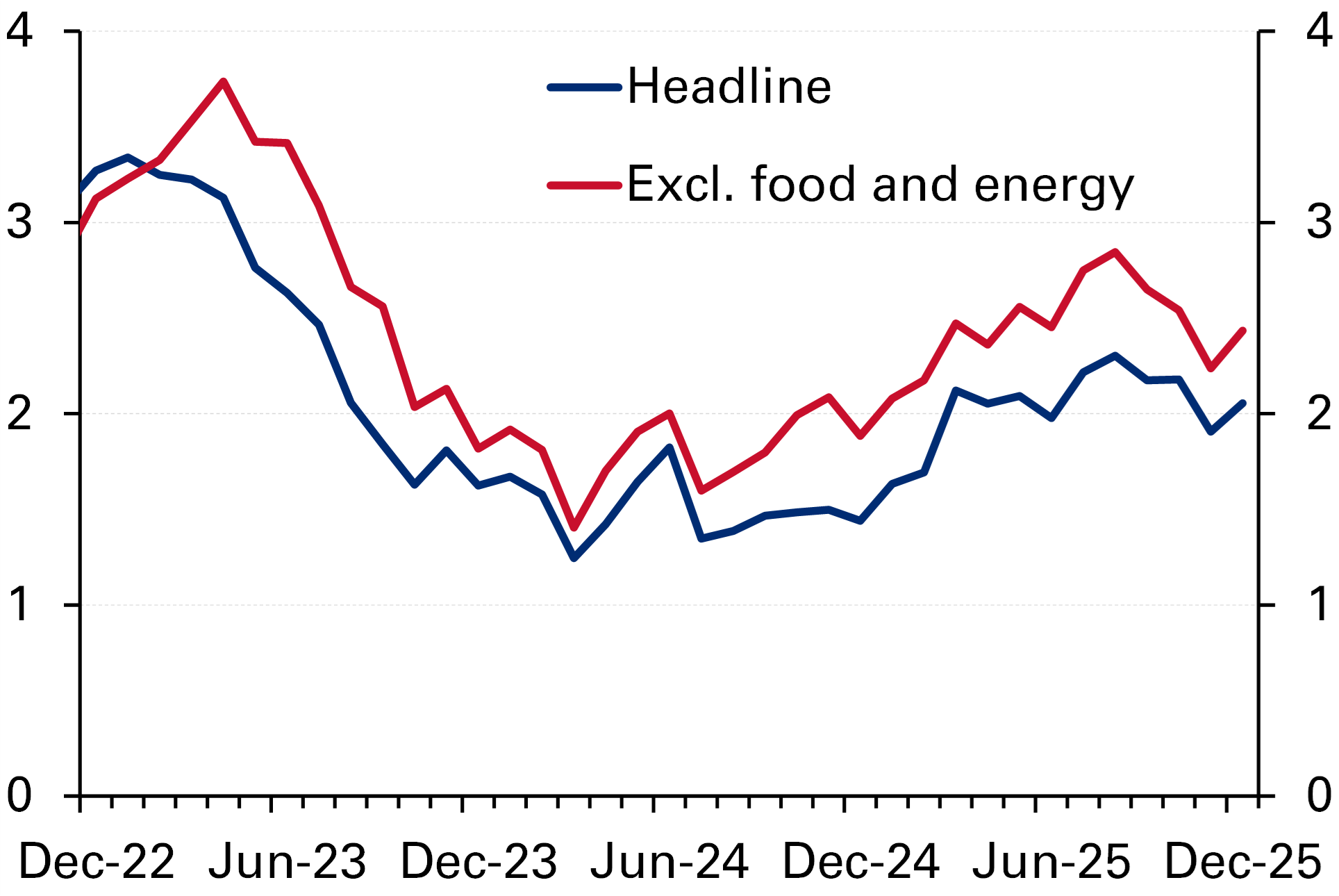
Saudi Arabia: Inflation picked up to 2.1% in December. Consumer price inflation rose to 2.1% y/y in December from 1.9% the previous month, driven mainly by higher inflation in the hotels & restaurants (0.9% from -0.5%) and recreation & culture (2.4% from 1.3%) components. Meanwhile, housing inflation eased for the 14th consecutive month, down to 4.1% from 4.3% the previous month, which is the lowest in over four years, driven mainly by the continued decline in rents inflation helped by various government measures including most recently the September decision to freeze rents in Riyadh. We expect this will lead to a continued easing of housing rent inflation over coming months, while inflation ex-housing may continue to drift upwards on rising input costs (wholesale price inflation at 3.1%, highest in more than two years) and strong demand thanks to the continued expansion of the private non-oil sector. In 2026, inflation is projected to remain steady at the 2025 average of 2.0%.